
Key takeaways
- Western Union expands its Solana-powered global payment infrastructure
- USDPT competes with Ripple's institutional stablecoin payment strategy
- XRP adoption depends on competitive liquidity and utility
Western Union (NYSE: WU) is transforming its traditional money transfer business into a blockchain-powered financial network, potentially intensifying competition with Ripple in the global cross-border payments market.
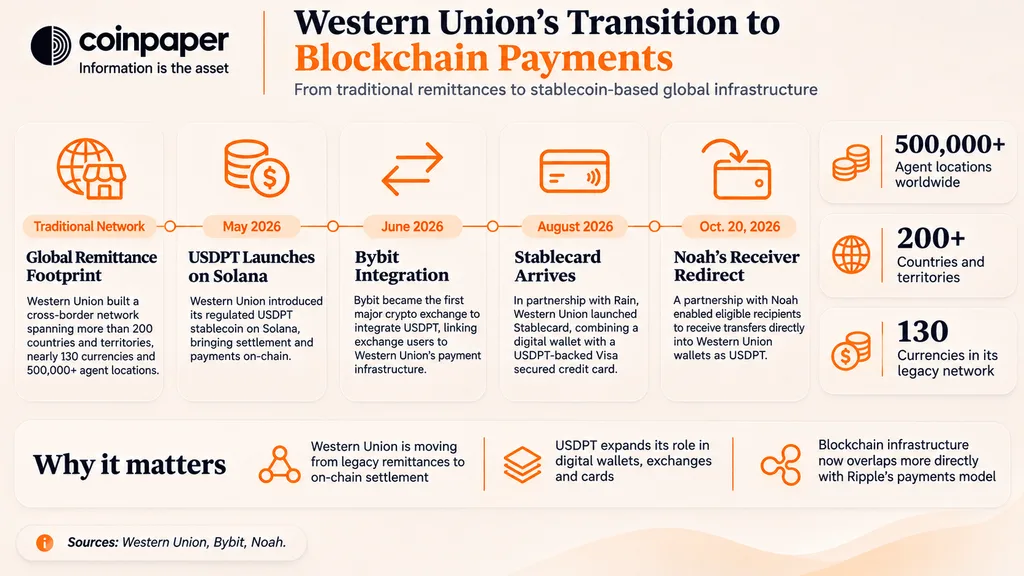
The company launched its dollar-backed stablecoin, USDPT, on Solana in May 2026, before expanding into cryptocurrency exchange integrations, digital wallets and stablecoin-backed payment cards.
With traditional financial companies increasingly adopting blockchain infrastructure, Ripple's competition is no longer limited to conventional payment networks such as SWIFT.
Western Union Is Bringing Its Global Payment Network On-Chain
Western Union's USDPT stablecoin is issued by Anchorage Digital Bank and operates on the Solana blockchain, providing a regulated digital dollar for settlement and consumer payments.
In June, Bybit became the first major exchange to integrate USDPT, connecting cryptocurrency users with Western Union's existing financial infrastructure.
The company subsequently launched Stablecard in partnership with Rain in August, combining a digital wallet with a USDPT-backed Visa secured credit card.
Its October 20 partnership with Noah introduced plans for Receiver Redirect, allowing eligible recipients to receive international money transfers directly into their Western Union wallets as USDPT.
Western Union's existing network encompasses more than 200 countries and territories, nearly 130 currencies and over half a million agent locations. This gives the company an established distribution network that could support widespread stablecoin adoption.
Western Union vs. Ripple: The Battle for Global Payments
Ripple has spent more than a decade developing blockchain-based financial infrastructure for banks, payment providers and other institutions.
According to its October 28 corporate update, Ripple Payments operates across more than 60 payout markets, with cumulative payment volume approaching $150 billion by year-end.
Its technology supports multiple settlement assets, including XRP, RLUSD and other stablecoins. Financial institutions such as Bitso already utilize XRP and RLUSD for cross-border payment applications.
Ripple has also developed institutional custody, liquidity management and tokenization services, extending its business beyond consumer remittances.
However, competition is intensifying as companies such as Visa also expand their stablecoin payment infrastructure.
Does Western Union's Stablecoin Strategy Threaten XRP?
Western Union's adoption of Solana demonstrates that blockchain-based international payments do not necessarily require XRP.
Dollar-backed stablecoins allow payment providers to transfer value without maintaining direct exposure to the price volatility associated with cryptocurrencies such as XRP.
Nevertheless, XRP can serve as a bridge asset between different currencies and liquidity pools where direct conversion routes are inefficient.
The relationship between XRP and RLUSD could also strengthen Ripple's competitive position by combining stablecoin settlement with cryptocurrency-based liquidity.