Key takeaways
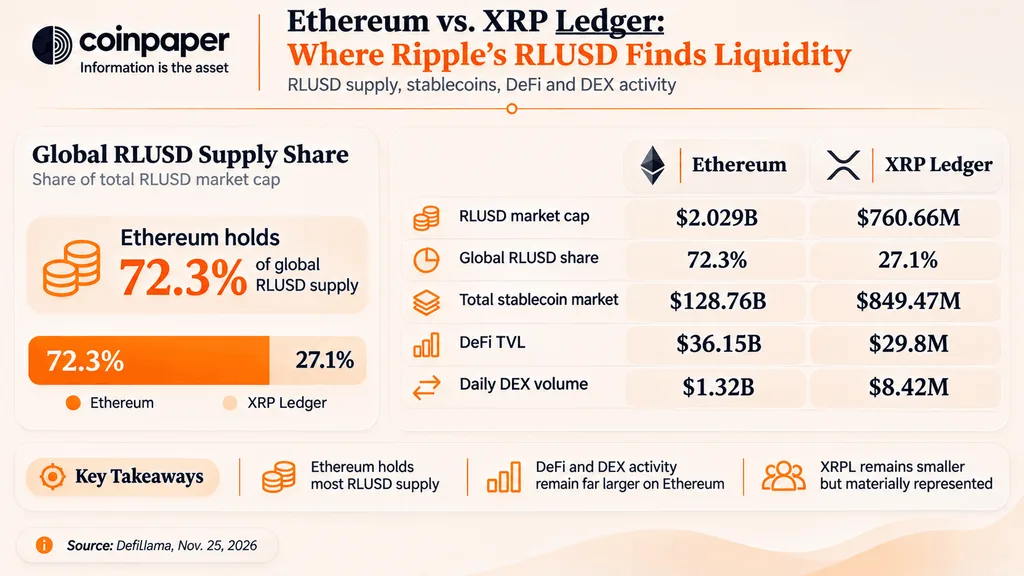
- Ethereum holds over 72% of circulating RLUSD supply
- Ethereum's DeFi ecosystem offers broader stablecoin applications
- Ripple continues expanding RLUSD across multiple blockchain networks
Despite Ripple's close association with XRP and the XRP Ledger, most of the company's dollar-backed stablecoin, RLUSD, currently circulates on Ethereum.
According to November 25 DefiLlama data, approximately $2.03 billion of RLUSD's $2.81 billion global capitalization resides on Ethereum, compared with $760.66 million on the XRP Ledger.
The disparity has widened considerably since September, when Ethereum's lead over XRPL stood at approximately $350 million. The difference now exceeds $1.26 billion.
Ethereum Offers a Much Larger DeFi Ecosystem
One potential explanation lies in the considerable differences between Ethereum and the XRP Ledger's decentralized financial infrastructure.
Ethereum currently hosts approximately $36.15 billion in DeFi total value locked (TVL) and $128.76 billion in stablecoins, according to DefiLlama.
In comparison, the XRP Ledger holds approximately $29.8 million in DeFi TVL and $849 million in stablecoin capitalization.
Ethereum's stablecoin market is therefore roughly 152 times larger, providing RLUSD with access to a considerably more established financial ecosystem.
Ethereum's ERC-20 token standard also provides compatibility with established wallets, exchanges and lending protocols, an advantage acknowledged in Ripple's developer documentation.
For example, Aave's Horizon lending market allows participants to borrow RLUSD against eligible tokenized real-world assets.
The availability of such applications expands the stablecoin's potential utility beyond conventional payments and transfers.
Ripple Never Intended RLUSD to Be Exclusive to XRPL
Ripple began testing RLUSD on both Ethereum and the XRP Ledger in August 2024, before officially launching the stablecoin in December that year.
Its distribution strategy has since expanded through institutional partnerships, exchange integrations and cross-chain infrastructure.
In July 2026, Ripple introduced Ripple Mint, enabling institutions to mint, redeem and manage RLUSD across supported blockchain networks.
Exchange support also influences where stablecoins circulate. Binance initially introduced RLUSD with Ethereum network support, while Ripple's October partnership with Coinbase enabled deposits and withdrawals across Ethereum, Base and XRPL.
Recent RLUSD minting and burning activity demonstrates how its distribution can change considerably over relatively short periods.
However, the recent $284 million supply reduction on XRPL occurred without a comparable decline in certain trading pool reserves, suggesting circulating supply and active trading liquidity do not always move together.
Does Ethereum's RLUSD Dominance Hurt XRP?
RLUSD circulating on Ethereum does not directly generate XRP Ledger transaction fees or necessarily create demand for XRP.
Nevertheless, the XRP Ledger remains an important component of Ripple's stablecoin infrastructure, particularly for payments and settlement applications.
According to Evernorth, approximately 92% of $1.65 billion in RLUSD swaps on the XRP Ledger during 2026 involved XRP as the direct trading pair.
The expanding relationship between RLUSD, XRP and decentralized lending could also introduce additional financial applications to the network.
Ultimately, Ethereum's dominance reflects the opportunities available within its established financial infrastructure rather than conclusive evidence that Ripple is abandoning XRPL.