Key takeaways
- Linde beats earnings estimates as semiconductor demand expands
- Electronics business grows 15% amid AI chip boom
- Company raises profit guidance and expands Arizona gas production
Linde reported stronger-than-expected third-quarter earnings on October 29 as the global artificial intelligence boom increased demand for industrial gases used to manufacture advanced semiconductors.
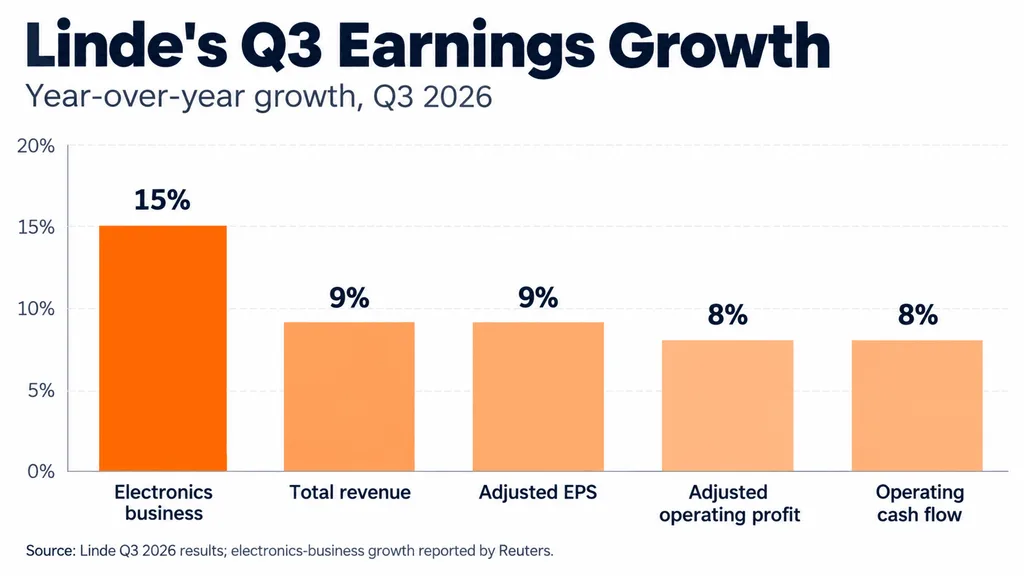
The world's largest industrial gases supplier generated record quarterly sales of $9.4 billion, up 9% year over year, while adjusted earnings per share reached $4.59, exceeding Wall Street's $4.52 estimate.
According to Linde's official earnings release, adjusted operating profit rose 8% to approximately $2.8 billion, with operating cash flow increasing to $3.2 billion.
Linde's Electronics Business Grows 15% as AI Chip Demand Accelerates
Linde's electronics business recorded approximately 15% growth, according to Reuters, supported by semiconductor manufacturers expanding production capacity for AI and high-performance computing.
Advanced chip factories require ultra-high-purity nitrogen, oxygen, hydrogen and other specialized gases throughout manufacturing. These materials support processes such as deposition, etching and contamination control.
Unlike semiconductor designers, industrial gas suppliers can earn revenue from long-term supply agreements tied to factory operations.
That business model is benefiting from the expansion previously highlighted in our SK Hynix earnings, where operating profit surged 632% as demand for AI memory accelerated.
Samsung has also experienced a substantial memory-chip recovery, demonstrating how AI demand is reshaping semiconductor production.
However, Linde's overall underlying sales growth was more modest at 5%, reflecting 3% higher pricing and 2% increased volumes across several industrial markets.
The company also reported GAAP earnings per share of $3.66, down 11%, illustrating the distinction between reported and adjusted profitability.
Linde Invests $1 Billion in Arizona Semiconductor Gas Infrastructure
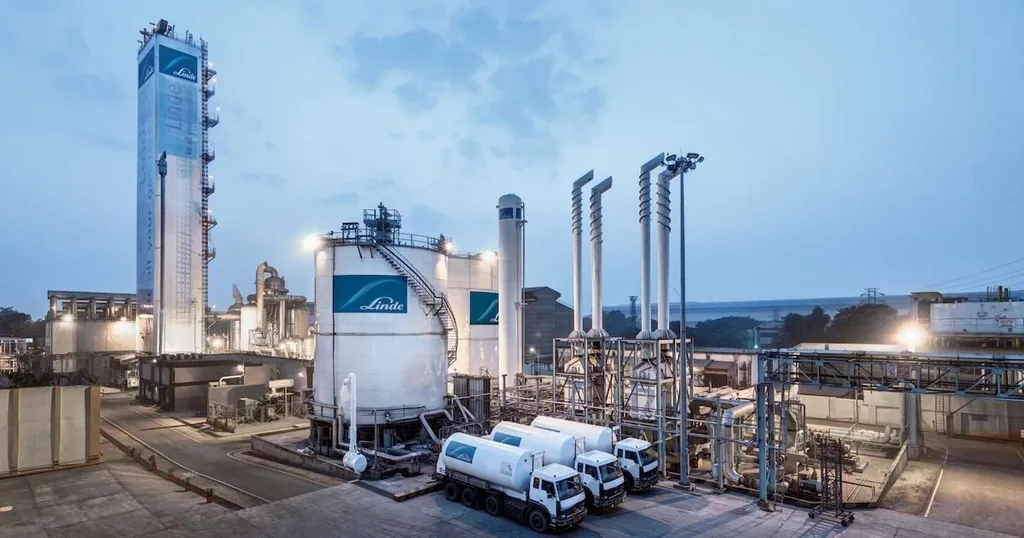
The electronics expansion is supported by a major investment in Arizona, where Linde announced plans in July to spend approximately $1 billion expanding an industrial gas complex in Phoenix.
Under a long-term supply agreement with an unnamed major semiconductor manufacturer, Linde will construct two additional air separation units to supply ultra-high-purity nitrogen, oxygen and argon.
The facilities will support two new semiconductor fabrication plants.
The project follows the broader US manufacturing expansion described in Coinpaper's TSMC coverage, although Linde has not publicly identified the customer under its agreement.
The opportunity extends beyond chips. As Coinpaper's AI supply-chain analysis explained, infrastructure spending generates business across industrial suppliers before many AI operators earn returns on their investments.
That helps explain why companies supplying essential manufacturing inputs can benefit from the expansion without developing AI models themselves.
Linde Raises 2026 Profit Forecast as Project Backlog Reaches $11 Billion
Following the earnings beat, Linde increased its full-year adjusted EPS forecast to $17.82–$17.92, representing expected annual growth of 8%–9%.
Management also projected fourth-quarter adjusted EPS of $4.40–$4.50 and reported an $11 billion total project backlog, including approximately $7.9 billion in contractual gas-supply projects.
The company expects capital expenditures of $5.5 billion–$6 billion for 2026, reflecting continued investment in production capacity.
Those commitments come as Microsoft, Amazon and Google prepare nearly $600 billion in AI spending.
Demand for new computing infrastructure could continue supporting semiconductor manufacturing, although delayed factory projects and weaker chip investment would remain risks.
The expansion also complements Nvidia's AI factory strategy, which aims to accelerate the deployment of computing infrastructure.