Key takeaways
- XRPL developers propose creating wallets without XRP deposits
- Sponsors would cover existing one XRP reserve requirements
- Validator approval remains necessary before mainnet activation
XRP Ledger developers are testing a new transaction that could allow users to open blockchain wallets without purchasing XRP, potentially removing a major obstacle for stablecoin payments and applications serving millions of customers.
The proposal, submitted on October 15, introduces SponsoredAccountCreate, a transaction allowing an existing account to create another wallet while covering its required XRP reserve.
According to the original GitHub submission, the new wallet would begin with zero XRP, while the sponsoring account assumes responsibility for the reserve.
The change could become particularly relevant to Ripple's RLUSD stablecoin and AI-powered payments, although its underlying sponsorship functionality has not yet received sufficient validator approval.
XRPL Proposal Moves 100,000 XRP Reserve Burden to Sponsors
Under existing XRP Ledger rules, every active account must maintain a base reserve of 1 XRP.
The requirement helps prevent spam and excessive network growth by making large-scale account creation carry an economic cost.
For a business opening 100,000 customer wallets, that means reserving 100,000 XRP before users can begin interacting with the network.
The proposed transaction would change who holds those tokens.
Instead of distributing XRP across thousands of customer accounts, a company could maintain the reserves through its sponsoring account, allowing end users to receive stablecoins without personally acquiring XRP.
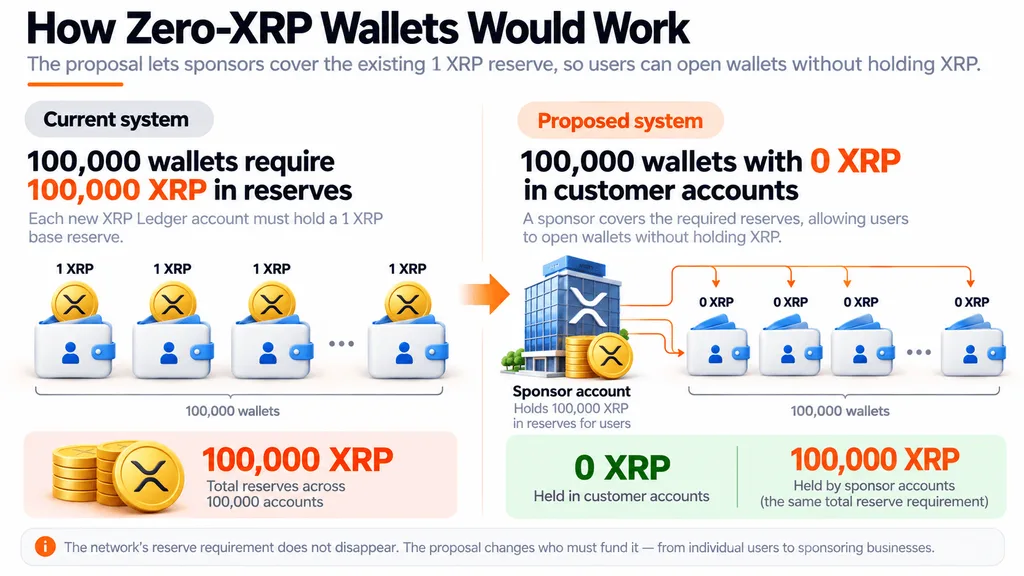
Importantly, this would not eliminate XRP's role in maintaining the ledger. The economic burden would shift from customers to businesses operating payment platforms.
The proposed functionality builds on XLS-68, the broader Sponsored Fees and Reserves framework, which also allows platforms to cover transaction fees without taking control of users' private keys.
Ripple's RLUSD and AI Payments Could Benefit From Sponsored Wallets
The proposal arrives shortly after Ripple partnered with Stripe-owned Privy to introduce embedded wallets for XRP Ledger applications.
The integration aims to simplify payments involving XRP, RLUSD and automated software agents.
However, even customers interested only in dollar-denominated stablecoins currently need XRP to activate new accounts.
Sponsored account creation could remove that onboarding requirement from the user's experience.
The initiative also fits Ripple's expanding AI payments strategy, which envisions software performing financial transactions without constant human intervention.
Meanwhile, RLUSD distribution continues growing through institutional partnerships.
Robinhood recently announced plans to introduce RLUSD access to its main retail application, potentially reaching a much wider audience.
Separately, BNY expanded custody support for XRP and RLUSD.
Neither partnership confirms that the institutions intend to implement sponsored wallets.
Why Zero-XRP Wallets Are Not Available Yet
The SponsoredAccountCreate code remains under review, with two automated code-review findings reported as unresolved.
More importantly, the transaction depends on the broader Sponsor amendment, which has not activated on the XRPL mainnet.
As of October 19, the amendment had 11 supporting validators out of 35, compared with the 29 votes required for its supermajority.
An October 28 secondary report placed support at 10 votes, suggesting that backing remains limited, although the newer tally requires dashboard confirmation.
XRPL amendments must maintain more than 80% validator support for two consecutive weeks before activation.
A separate network upgrade delay recently demonstrated how losing that majority can reset an activation countdown.
Other proposed lending and privacy features have faced similar approval hurdles.