In This Article
The Nervos Network stepped up as a unique Layer-1 blockchain that is focused on long-term sustainability, scalability, and a novel tokenomics model. At the heart of this system lies its halving mechanism, which is an essential process that gradually reduces token issuance and shapes the long-term value of its native cryptocurrency, CKB (Common Knowledge Byte).
Understanding Nervos Network halving dates is crucial for investors, miners, and developers, as these events directly impact inflation, mining rewards, and market dynamics.
This guide breaks down everything you need to know—from how halving works to a full schedule of past and future halving events.
What Is Nervos Network (CKB)?
The CKB token powers the Nervos Network, a Proof-of-Work blockchain designed with a layered architecture. Its base layer (Layer 1) focuses on security and decentralization, while Layer 2 handles scalability and applications.
Unlike many blockchains, Nervos introduces a dual issuance model:
Primary issuance (base rewards) – subject to halving
Secondary issuance – fixed annual issuance used to maintain long-term miner incentives
This hybrid approach makes Nervos fundamentally different from networks like Bitcoin.
What Is a Nervos Halving?
A halving is a pre-programmed event where the base issuance rewards for miners are cut in half.
Occurs every 4 years
Reduces new CKB entering circulation
Lowers inflation over time
In Nervos, halvings are tied to epochs (time periods of 4 hours), with one halving occurring every 8,760 epochs (4 years).
Unlike Bitcoin, Nervos halvings only affect primary issuance, while secondary issuance continues unchanged to ensure ongoing miner incentives.
Nervos Network Halving Dates
Below is the official halving schedule based on the Nervos tokenomics model:
Past Halving
Genesis Launch: November 2019
1st Halving: November 19, 2023
Upcoming Halving Dates
2nd Halving: November 2027
3rd Halving: November 2031
4th Halving: November 2035
5th Halving: November 2039
6th Halving: November 2043
7th Halving: November 2047
8th Halving: November 2051
9th Halving: November 2055
10th Halving: November 2059
This halving cycle will continue until approximately 2103, when all primary issuance is exhausted.

Nervos Network halvings (Source: Nervos Network)
How Nervos Halving Works
The Nervos Network distributes a fixed amount of CKB every epoch. Every four years:
The base issuance is cut by 50%
The number of newly minted tokens decreases
Inflation slows down significantly
For example:
Before the first halving: 4.2 billion CKB/year
After 2023 halving: 2.1 billion CKB/year
After 2027 halving: 1.05 billion CKB/year
This predictable supply reduction helps stabilize the network’s long-term economics.
Why Nervos Halving Matters
1. Reduced Inflation
Each halving lowers the rate at which new tokens enter circulation, making CKB more scarce over time.
2. Mining Economics Shift
Mining rewards decrease, meaning:
Inefficient miners may exit
More efficient operations dominate
3. Market Impact
Like Bitcoin, halvings can:
Influence price cycles
Attract investor attention
Trigger supply-demand shifts
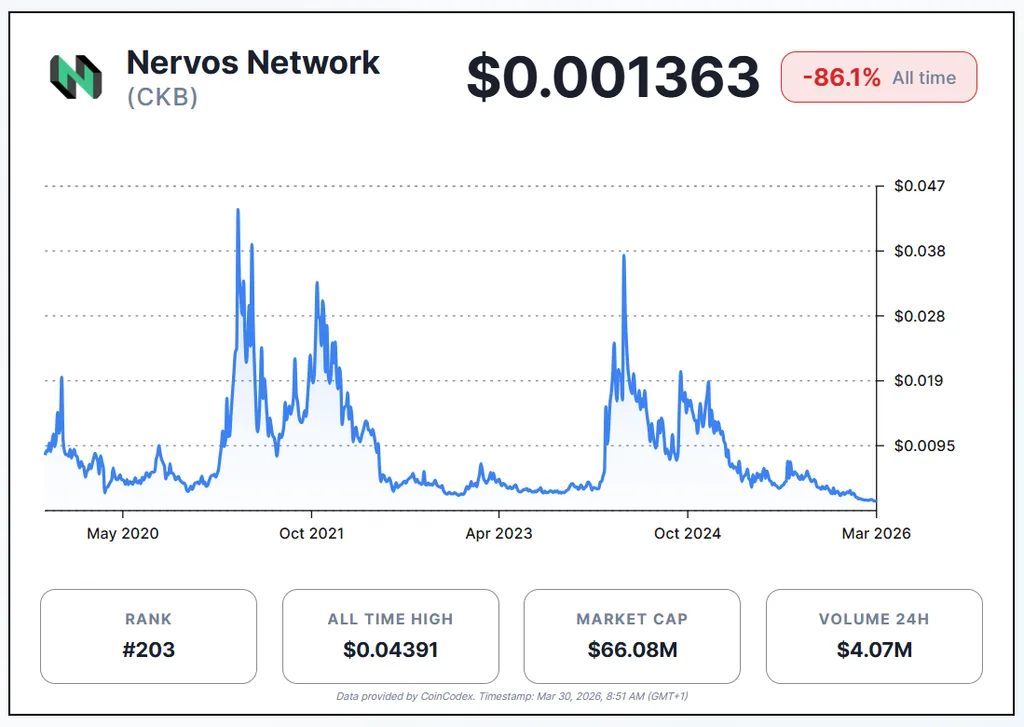
CKB’s all-time price action (Source: CoinCodex)
4. Long-Term Sustainability
Because Nervos includes secondary issuance, miners still earn rewards even after primary issuance declines—solving a major issue seen in other PoW systems.
Nervos vs Bitcoin Halving: Key Differences
| Feature | Nervos Network | Bitcoin |
| Halving frequency | 4 years | 4 years |
| Affects all rewards? | No (only base issuance) | Yes |
| Secondary issuance | Yes | No |
| Long-term miner incentives | Sustained via inflation | Depends on fees |
| Supply model | Hybrid (finite + infinite) | Fixed supply (21M) |
Nervos is designed to avoid the “security drop-off” problem that could occur in Bitcoin when block rewards eventually reach zero.
Long-Term Tokenomics Outlook
The Nervos Network will issue:
33.6 billion CKB through primary issuance over 84 years
Continuous secondary issuance to support miners
Over time:
Primary issuance → decreases to zero
Secondary issuance → becomes dominant
This creates a transition from inflationary to sustainable economic security, rather than abrupt changes.
FAQ: Nervos Network Halving Dates
When was the first Nervos halving?
The first halving occurred on November 19, 2023, reducing base issuance by 50%.
When is the next Nervos halving?
The next halving is expected in November 2027.
How often does Nervos halve?
Approximately every 4 years (8,760 epochs).
How many halvings will there be?
There will be multiple halvings until around 2103, when primary issuance ends.
Does halving affect all mining rewards?
No. It only affects base issuance—secondary issuance and fees remain active.
Is Nervos deflationary?
Partially. While base issuance decreases over time, secondary issuance introduces controlled inflation, making it a hybrid model.
Why is Nervos different from Bitcoin?
Nervos includes a secondary issuance mechanism, ensuring miners are always incentivized—even after halvings reduce base rewards.
Final Thoughts
Nervos Network halving dates play a critical role in shaping the long-term economics of the ecosystem. With a predictable four-year cycle, decreasing base issuance, and a unique dual-token emission model, Nervos offers a more sustainable alternative to traditional Proof-of-Work systems.
For investors and developers, understanding these halving events provides valuable insight into future supply dynamics, miner behavior, and potential market cycles.