Key takeaways
- Bitcoin has gained approximately 499% since its $10,000 milestone
- Gold slightly outperformed the S&P 500 in price returns
- Bitcoin's superior returns came with substantially greater volatility
On November 29, 2017, Bitcoin (BTC) crossed $10,000 on major cryptocurrency exchanges, marking a historic moment for an asset that had spent much of its early existence outside mainstream finance.
Nine years later, Bitcoin is trading around $60,000 despite experiencing multiple market crashes, regulatory challenges and periods of institutional skepticism.
While its recent underperformance against technology stocks has raised concerns among investors, its longer-term performance tells a considerably different story.
Bitcoin vs. Gold and the S&P 500: Nine Years of Returns
When Bitcoin first reached $10,000 in November 2017, gold traded near $1,275 per ounce, while the S&P 500 stood at 2,626 points, according to Federal Reserve data.
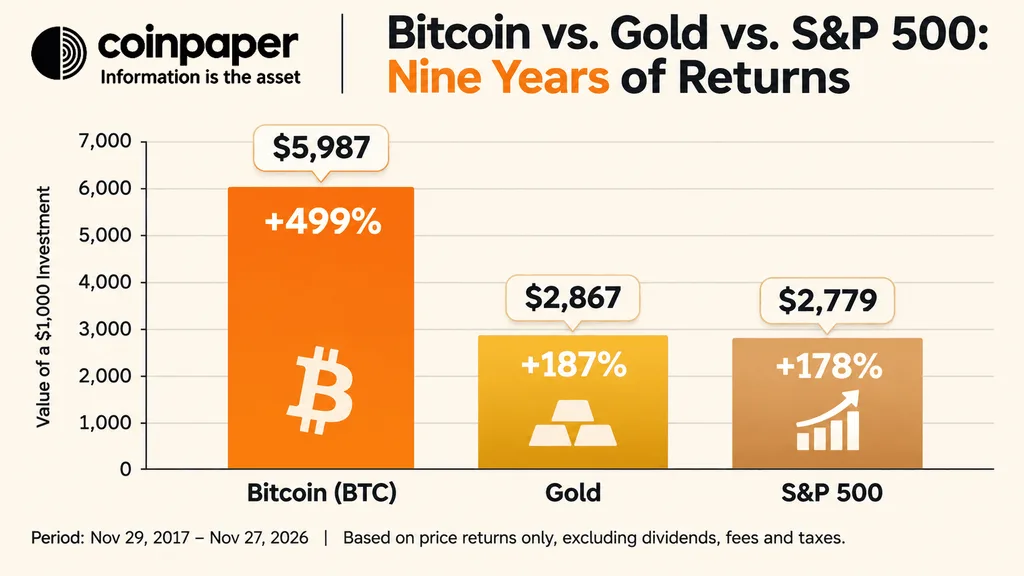
By November 27, 2026, Bitcoin was trading near $59,870, gold had reached approximately $3,654, and the S&P 500 stood near 7,297 points.
Based on these benchmarks, Bitcoin delivered a cumulative price return of approximately 499%, compared with 187% for gold and 178% for the S&P 500.
A hypothetical $1,000 investment in Bitcoin would consequently be worth approximately $5,987, compared with $2,867 for gold and $2,779 for the S&P 500.
However, this comparison excludes reinvested stock dividends, which would improve the S&P 500's overall investment returns.
From Speculative Cryptocurrency to Institutional Asset
Bitcoin's investment landscape has changed considerably since 2017, when cryptocurrency trading remained largely dominated by retail participants.
One of its most significant milestones occurred in January 2024, when the US Securities and Exchange Commission approved the listing and trading of spot Bitcoin exchange-traded products.
The decision expanded access to Bitcoin through traditional brokerage accounts, allowing investors to gain exposure without directly managing cryptocurrency wallets.
However, institutional participation has not eliminated Bitcoin's volatility, as demonstrated by recent substantial ETF withdrawals.
Furthermore, Bitcoin's evolving relationship with gold suggests that its role within diversified investment portfolios remains subject to changing market conditions.
Can Bitcoin Continue Outperforming Traditional Assets?
Despite its superior nine-year returns, Bitcoin has experienced significantly deeper corrections than most traditional investment benchmarks.
Investors purchasing near Bitcoin's $69,000 peak in 2021 would still be facing losses at current prices, demonstrating how entry timing can dramatically influence investment outcomes.
Unlike the S&P 500, Bitcoin does not generate corporate earnings or dividends. Its valuation depends largely on scarcity, network adoption, liquidity and investor demand.
Gold, meanwhile, benefits from established demand across central banks, jewelry markets and investment portfolios.
Although Bitcoin has increasingly demonstrated characteristics associated with traditional stores of value, its future returns remain uncertain.