Key takeaways
- JPMorgan and DBS launch round-the-clock blockchain dollar transfers
- Tokenized bank deposits operate without XRP bridge liquidity
- JPMorgan and Ripple have previously demonstrated blockchain interoperability
JPMorgan is expanding its blockchain-based payment infrastructure, demonstrating that financial institutions can execute cross-border transactions around the clock without necessarily relying on cryptocurrencies such as XRP.
On November 16, JPMorgan's Kinexys division and Singapore's DBS launched an interoperability solution enabling institutional clients to transfer US dollars between blockchain-based bank accounts in Singapore and the United States.
The development comes as SWIFT builds its own blockchain network, intensifying competition across the international payments industry and raising questions about XRP's long-term role.
How JPMorgan Moves Money Without XRP
The new service connects DBS Token Services with Kinexys' permissioned blockchain deposit infrastructure. Ant International became the first client to adopt the solution for managing corporate treasury operations across both markets.
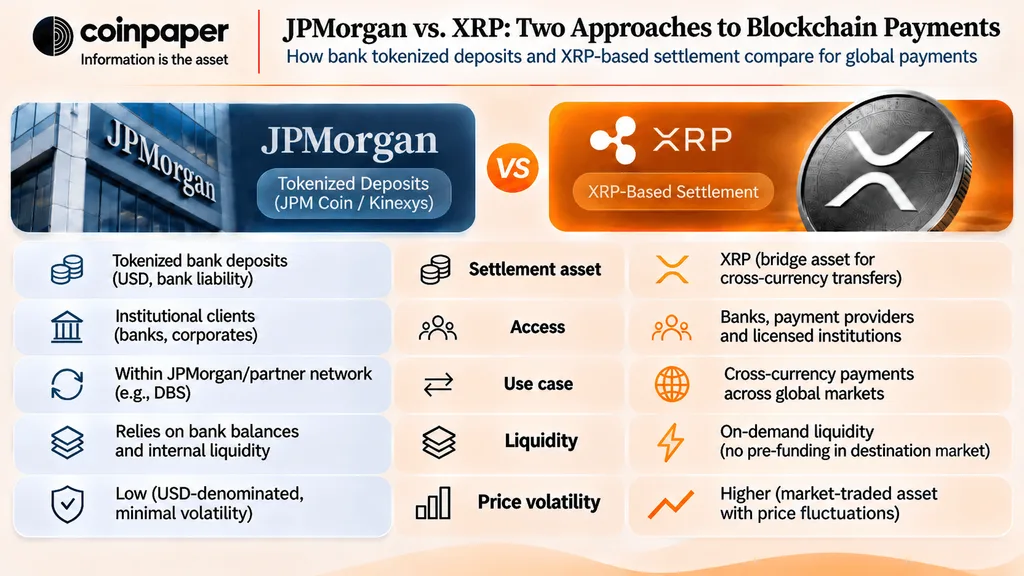
Unlike XRP, tokenized bank deposits represent commercial bank liabilities denominated in traditional currencies. Institutions can transfer these digital representations of dollars without purchasing a separate cryptocurrency.
JPMorgan has also expanded beyond its private blockchain infrastructure. In October, the bank introduced its JPM Coin deposit token on Ethereum, extending institutional access beyond its earlier deployment on Coinbase's Base network.
These developments demonstrate that financial institutions can combine blockchain settlement with existing banking relationships, potentially reducing the need for independent bridge assets in certain payment corridors.
However, transferring dollars between two blockchain-based bank accounts does not address every challenge associated with exchanging different currencies across fragmented liquidity markets.
Where XRP Could Still Have an Advantage
XRP was designed to facilitate exchanges between different currencies and assets without requiring financial institutions to maintain large prefunded balances in every destination market.
According to Ripple's payment documentation, XRP can act as an intermediary asset between fiat currencies, allowing payment providers to source liquidity when transactions occur.
This approach could remain valuable in markets where direct currency trading pairs are inefficient or banking connectivity is limited.
Latin American payment provider Bitso, for example, already uses XRP and RLUSD alongside Ripple Payments to facilitate international money transfers.
Nevertheless, competition extends beyond JPMorgan. Stablecoins increasingly provide blockchain-based liquidity without exposing users to the same price fluctuations as XRP.
Ripple's own RLUSD stablecoin reflects this evolving market, offering institutions an alternative settlement asset within the company's broader financial ecosystem.
Could JPMorgan and XRP Coexist?
Interestingly, JPMorgan and Ripple have already demonstrated that their respective technologies can complement one another.
Earlier in 2026, Ripple, Mastercard, Ondo Finance and JPMorgan participated in a cross-border settlement transaction connecting tokenized securities on the XRP Ledger with traditional banking infrastructure.
The transaction demonstrated interoperability between public blockchain infrastructure and institutional banking networks, rather than confirming JPMorgan's adoption of XRP as a settlement currency.
Ultimately, JPMorgan's expansion challenges the assumption that widespread blockchain adoption will automatically generate demand for XRP.