Key takeaways
- Britain can issue digital sterling without XRP
- Ripple’s 2017 trial tested synchronised wholesale settlement
- XRP’s cross-border role depends on competitive liquidity
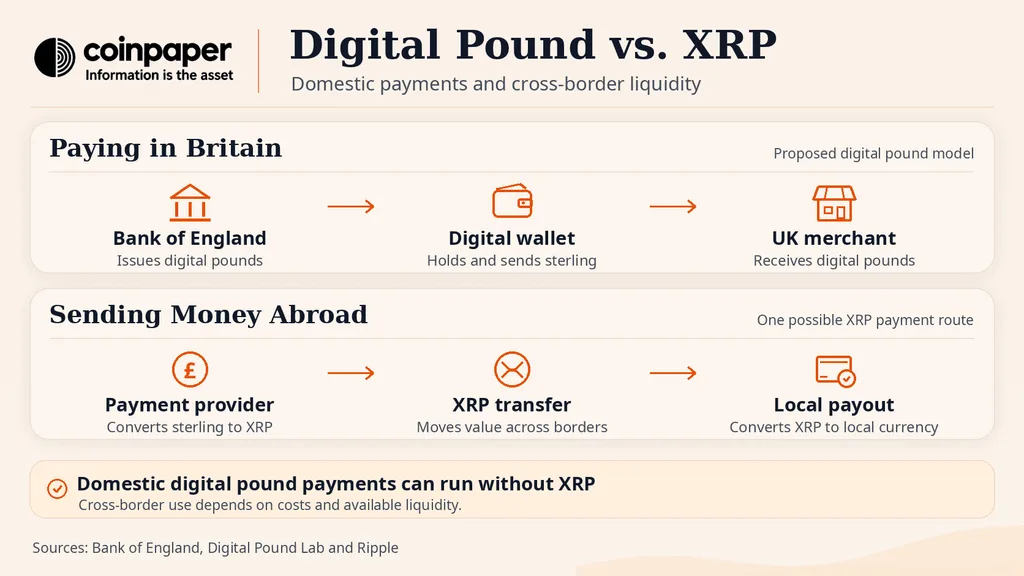
Britain could launch a digital pound without using XRP. The Bank of England’s proposed central bank digital currency would let households and businesses pay with digital sterling issued by the central bank.
XRP’s potential role lies elsewhere, when payment providers need to move value from one currency to another.
The Bank and HM Treasury expect to publish a blueprint and a decision on next steps in 2026. The November regulatory initiatives grid says a final decision is still pending, and Parliament would need to pass legislation before any launch.
Why the Digital Pound Wouldn’t Need XRP
Under the Bank’s proposed model, the central bank would issue the money and private firms would provide wallets.
A £10 balance would be worth £10 in cash, so a customer paying a UK shop in digital pounds would have no reason to convert their sterling into XRP first.
The Digital Pound Lab demonstrated more than 30 uses in a simulated environment, from buying goods offline to settling trade finance transactions.
The network choice matters here. XRP covers transaction fees for assets moving on the XRP Ledger, and the Mastercard settlement trial was announced with Ripple’s dollar stablecoin RLUSD on that network. The Bank’s published digital pound design has no requirement to use that ledger.
Where XRP Could Fit in UK Payments
The Bank did work with Ripple in 2017. Its proof of concept used the Interledger Protocol to synchronise the movement of two currencies across simulated wholesale settlement systems.
The published report describes a technology test, and the Bank says the engagement ended when the experiment was complete.
The Bank’s newer Meridian FX APAC experiment tested a different way to settle foreign exchange. Working with the central banks of Singapore and Thailand, the Bank coordinated both sides of a currency trade across test systems that settled in central bank money.
One currency could move only if the other was ready to move too.
A provider could buy XRP with pounds, send it abroad, and sell it for local currency. That can make sense on some routes.
Costs depend on exchange spreads, XRP trading liquidity, and local payout fees. Ripple’s UK permissions allow it to expand its commercial payments offering.
Providers can also choose bank rails or stablecoins. Ripple’s Bitso settlement project pairs a peso-backed stablecoin with RLUSD for the US–Mexico corridor, and RLUSD runs across networks.