Key takeaways
- Eight central banks explore tokenized international payment infrastructure
- Project Agorá settled real-value test payments within seconds
- XRP faces competition from tokenized commercial bank money
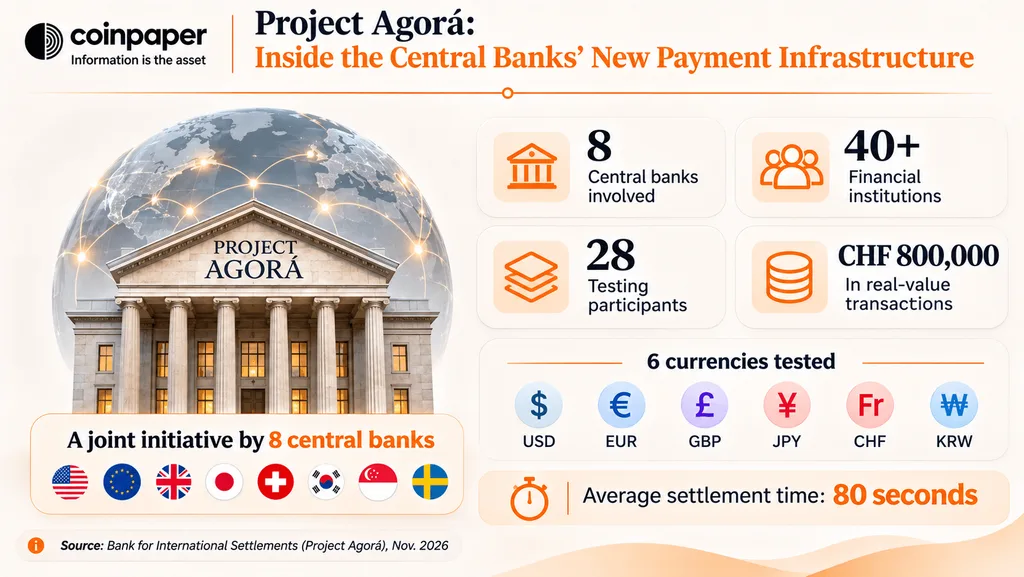
Eight central banks and more than 40 financial institutions are developing an experimental payment infrastructure that could reshape how money moves across borders. The initiative addresses many of the same inefficiencies Ripple and XRP were originally designed to solve.
Known as Project Agorá, the initiative brings together the Bank for International Settlements (BIS), the Institute of International Finance and major financial institutions. On November 3, the BIS described it as its largest public-private collaboration to date, highlighting progress beyond simulated transactions.
The project comes as SWIFT develops its blockchain ledger, raising questions about whether traditional financial institutions will eventually require independent digital assets such as XRP.
Central Banks Are Testing a New Way to Move Money
Project Agorá combines digital representations of commercial bank deposits and central bank reserves within a shared programmable infrastructure. The objective is to simplify international payments without abandoning the existing monetary system.
During real-value testing in July 2026, 28 participating institutions conducted transactions worth approximately CHF 800,000 across 17 different payment scenarios. Individual transfers ranged from CHF 9,000 to CHF 125,000, with settlement taking approximately 80 seconds on average.
Participants tested payments involving six currencies: the U.S. dollar, euro, British pound, Japanese yen, Swiss franc and South Korean won.
Unlike conventional international transfers, which often involve sequential processing across intermediaries, the prototype allows linked transaction components to settle together. Programmable conditions could also reduce manual reconciliation and operational delays.
Similar modernization efforts are already emerging in securities markets, including the European Central Bank's Pontes settlement infrastructure.
Why Project Agorá Could Challenge XRP
XRP was designed to facilitate liquidity between currencies. Instead of maintaining substantial balances in foreign markets, payment providers can use XRP as an intermediary asset and convert it into the destination currency.
Project Agorá approaches this problem differently. Its architecture relies on tokenized deposits, central bank reserves and participating liquidity providers rather than a publicly traded cryptocurrency.
This distinction matters because banks could obtain some of the operational benefits associated with blockchain payments without exposing themselves to XRP's price volatility.
Ripple has nevertheless demonstrated commercial applications for this alternative liquidity model. Latin American payment provider Bitso uses XRP and RLUSD alongside Ripple Payments to facilitate international transfers.
Where Could XRP Fit Into the New Banking System?
One potential opportunity lies outside the central banks' immediate settlement infrastructure. As public and private financial networks expand, institutions may require additional mechanisms for transferring liquidity between otherwise separate platforms.
A previous transaction involving Ripple, Ondo Finance, Mastercard and JPMorgan demonstrated how tokenized assets on XRPL could interact with conventional banking infrastructure.
Ripple is also expanding its stablecoin strategy, while BNY's custody services provide institutions with another avenue for accessing XRP and RLUSD. Notably, BNY also participated in Project Agorá's real-value testing.