Key takeaways
- Federal Reserve governor outlines future of blockchain payments
- Tokenized settlement creates potential opportunities for XRP Ledger
- No Federal Reserve adoption of XRP has been announced
Will the Federal Reserve ever use XRP? The question is gaining relevance after Federal Reserve Governor Christopher Waller delivered a major speech on November 17 outlining how blockchain technology, stablecoins and tokenized assets could reshape the US payment system.
Speaking at The Clearing House Annual Conference in New York, Waller described growing connections between traditional financial infrastructure and blockchain-based markets.
His official Federal Reserve remarks emphasized interoperability, programmable settlement and the potential coexistence of traditional payment rails with tokenized money.
Federal Reserve Signals Growing Interest in Blockchain Settlement
Waller identified tokenization as an increasingly important development in financial markets, with institutions exploring how blockchain networks can support securities, banking deposits and payments.
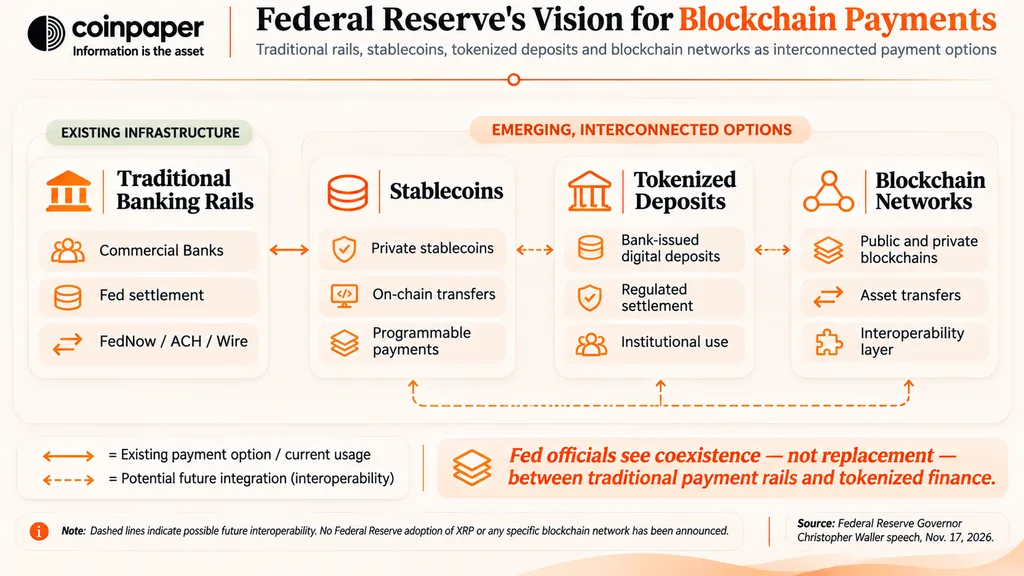
He noted that stablecoins are already being used to settle obligations within card networks, while financial institutions are developing systems for tokenized deposits.
The Fed governor also highlighted how programmable payments could allow money and tokenized securities to exchange hands simultaneously, potentially reducing settlement delays.
However, he stressed that different financial applications will require different settlement approaches.
His comments follow the Federal Reserve's earlier FedNow expansion proposal, which renewed discussion about how fintech providers could connect with established banking infrastructure.
Waller's speech did not announce any integration between FedNow and blockchain networks. Instead, he described a future in which multiple payment systems coexist.
Could XRP Ledger Become Part of the Fed's Payment Ecosystem?
Ripple's technology addresses several issues raised in Waller's speech, particularly cross-border settlement, interoperability and the movement of value between different currencies.
According to Ripple's official documentation, XRP can function as a bridge asset within the XRP Ledger, facilitating exchanges between assets.
Ripple also issues RLUSD, a dollar-backed stablecoin available on the XRP Ledger and other supported blockchain networks.
The distinction matters because transactions involving RLUSD do not necessarily require XRP as the asset being transferred.
The potential relationship between XRP and established financial networks has already attracted attention following SWIFT's blockchain payment initiative.
Similarly, the Mastercard and Ripple partnership involves exploring RLUSD settlement on the XRP Ledger, demonstrating how blockchain infrastructure can support conventional financial services without necessarily using XRP as the principal settlement asset.
For Federal Reserve adoption to become realistic, a specific operational use case, appropriate regulatory framework and confirmed technical arrangements would be necessary.
None has been announced for XRP.
Will the Federal Reserve Adopt XRP in the Future?
Waller's remarks suggest that the Federal Reserve expects blockchain infrastructure to become increasingly connected with established markets.
However, he also emphasized the continued importance of central bank money and traditional payment rails in maintaining financial stability.
The Fed's role is therefore different from that of private companies developing cryptocurrency settlement products.
Previous Ripple-related FedNow discussions have generated speculation, but technical compatibility or third-party connections do not establish official XRP adoption.
Meanwhile, Ripple's participation in DTCC's tokenization initiative illustrates its increasing involvement in institutional financial infrastructure, even where the token's direct role remains unconfirmed.