
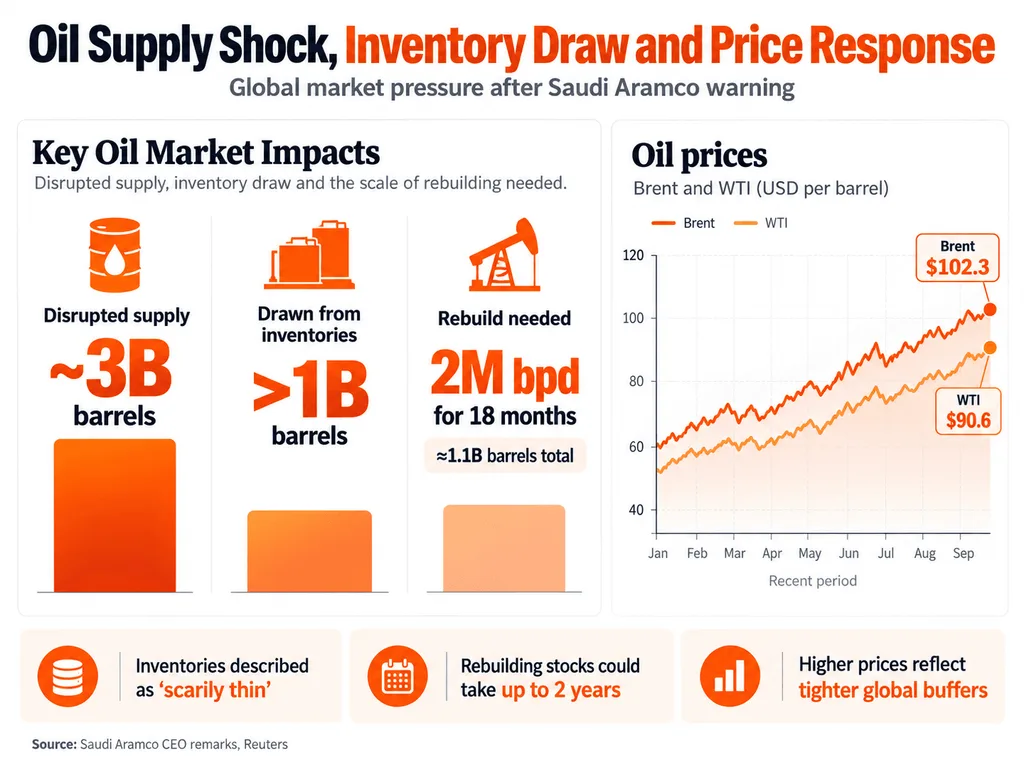
CEO Amin Nasser said at the Energy Intelligence Forum in London that global crude and refined-product inventories are now “scarily thin” and could take as long as two years to replenish. Nearly 3 billion barrels of supply have been lost since the war involving the U.S., Israel and Iran began in February, while more than 1 billion barrels have already been drawn from inventories to soften the shock.
Nasser estimated the world would need roughly 2 million additional barrels per day for 18 months simply to rebuild those stocks while still meeting ongoing demand.
That warning comes even as Middle Eastern oil flows have recovered to roughly 98% of pre-war levels. The contrast is important: supply routes are recovering, but the buffer that previously protected the market from new disruptions has already been heavily depleted.
6 Billion Barrels Sounds Bigger Than It Is
Nasser said less than 6 billion barrels of commercial inventory remain globally, but only a small fraction is realistically available to the market.
Reuters reported that roughly 10% of those stocks may be practically accessible, meaning headline inventory totals overstate how much oil can actually be deployed during another disruption.
Governments have already turned to emergency reserves. The G7 recently announced a 100M-barrel release of crude and diesel, but Nasser said releases can only offer temporary relief if commercial inventories remain depleted.
Brent Above $100 Shows the Cushion Is Still Missing
Oil prices continue to reflect that tightness.
Brent was trading around $102.30 per barrel on Monday, while WTI stood near $90.62, despite stronger Gulf exports and fresh reserve releases.
The impact is already spreading beyond energy markets. Brent’s move above $100 has revived inflation pressure across import-dependent economies, while earlier attacks on Saudi infrastructure pushed the market toward another $120 scenario.