

U.S. stocks fell Tuesday as a sharp semiconductor selloff and another surge in long-term Treasury yields outweighed strength in energy shares. Around midday on Aug. 18, the S&P 500 was down about 0.6%, the Dow Jones Industrial Average was close to flat, and the Nasdaq Composite had dropped roughly 1.4%, leaving technology as the clear weak spot on Wall Street.
The selloff came as investors faced a combination of expensive valuations in artificial intelligence stocks, higher borrowing costs and renewed geopolitical risk. Brent crude remained near $91 a barrel after U.S.-Iran diplomacy stalled, adding another inflation concern for markets already dealing with elevated bond yields.
Chip Rout Pushes Nasdaq Lower as Volatility Builds
Semiconductors suffered the heaviest selling. The Philadelphia Semiconductor Index dropped sharply, while several chip and memory-related stocks posted steep declines. Nvidia and other major technology names also moved lower as investors trimmed exposure to one of the market's strongest areas.
Market commentary from Proflex Finance (@ProflexFinance) highlighted the widening gap between the Nasdaq and Dow, weakness across semiconductor and memory stocks and Wednesday's Cboe VIX options expiration as potential sources of short-term volatility.
The broader market action supports that cautious tone. The Nasdaq's steeper decline compared with the Dow shows that Tuesday's weakness remained concentrated in growth and technology shares rather than spreading evenly across the market.
Volatility could become even more important next week.
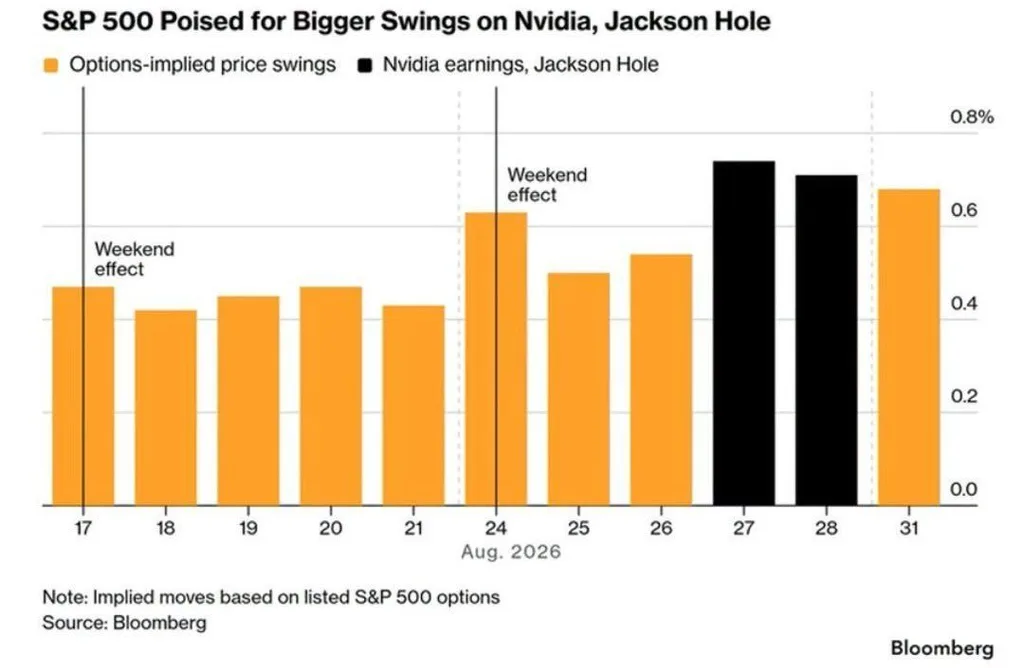
IS&P 500 Options-Implied Swings Ahead of Nvidia Earnings and Jackson Hole. Source: Bloomberg /X
The Bloomberg chart shows options traders expecting daily S&P 500 moves of roughly 0.4% to 0.6% through much of the current period before implied swings rise toward about 0.7% around Aug. 27 and Aug. 28.
Those dates put two major market catalysts in focus: Nvidia's quarterly earnings and the Federal Reserve's Jackson Hole symposium. Nvidia remains a key barometer for artificial intelligence spending and semiconductor demand, while Jackson Hole could reshape expectations for interest rates and monetary policy.
The chart therefore suggests that options traders expect the relatively contained swings seen this week to give way to larger moves as those events approach.
Dow Jones Tests Important Short-Term Support
The Dow Jones has held up much better than the Nasdaq, but its technical picture is also reaching an important point after the index pulled back from its recent high.
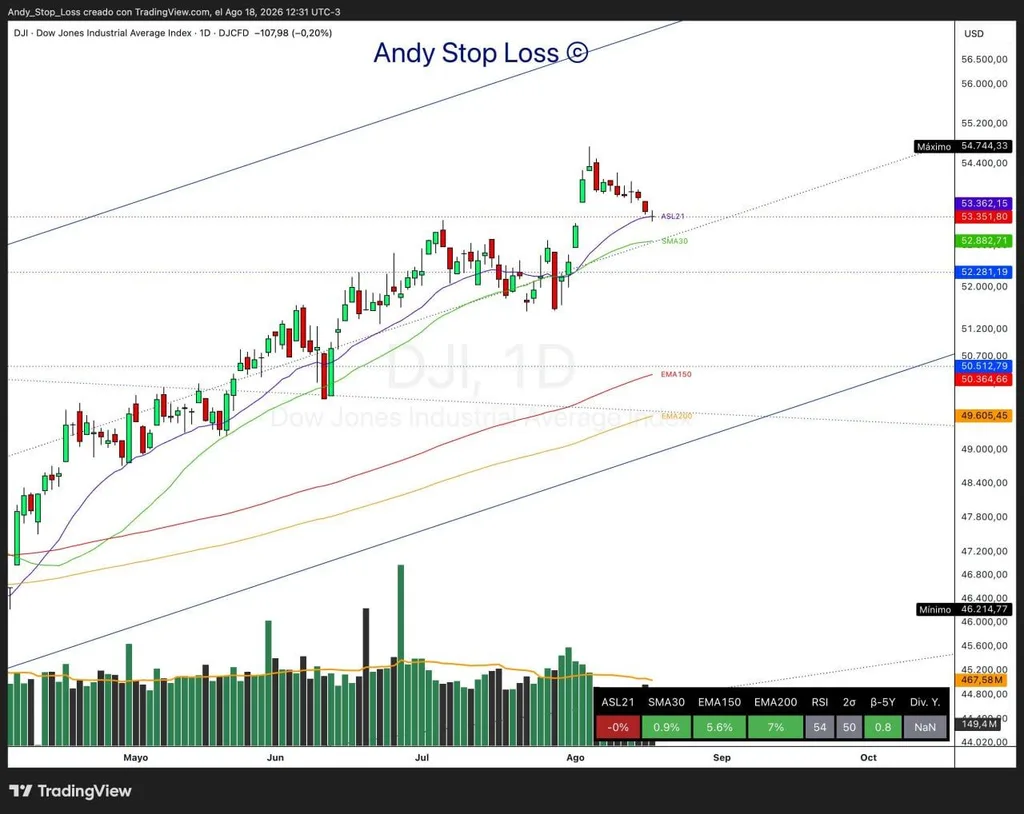
Dow Jones Tests ASL21 Support After Pullback From August High. Source: Andy Stop Loss (@AndyStopLoss1) via TradingView
The supplied daily TradingView chart places the Dow near 53,352, almost directly against the ASL21 indicator at roughly 53,362.
Andy Stop Loss describes the ASL21 as dynamic support and views the current pullback as a pause within the broader uptrend rather than a confirmed bearish reversal.
That interpretation remains intact as long as buyers continue defending the area.
Below the ASL21, the chart shows the 30-day moving average near 52,883, giving the Dow another nearby support level. A deeper decline could then put the marked 52,281 zone into focus.
On the upside, the recent high around 54,744 remains the main resistance level. A rebound above that area would strengthen the bullish case and signal that the latest decline was only a consolidation.
Treasury Yields and Oil Add Pressure to Stocks
Bond yields remain another major obstacle for equities.
The 30-year Treasury yield climbed above 5.3% Tuesday, while the 10-year yield remained elevated near 4.7%. Rising yields increase borrowing costs and can weigh especially heavily on growth stocks because investors discount future earnings more aggressively when risk-free bond returns rise.
Oil prices added another layer of pressure.
Brent crude traded above $91 a barrel and WTI remained near $85 as renewed U.S.-Iran tensions and uncertainty around the Strait of Hormuz raised concerns about global energy supplies.
Higher oil prices can reinforce inflation worries, making it harder for investors to expect a rapid decline in interest rates.
That combination of expensive energy, elevated Treasury yields and weaker technology shares explains why the S&P 500 struggled Tuesday even as the Dow avoided a much steeper decline.


