When Ethereum’s core developers met on 19 November, Glamsterdam had been running on a test network for more than six weeks. The next rehearsal had stalled over a question the first activation had left open. The upgrade aims to give Ethereum more capacity and changes how the network accounts for the work that transactions require. Some applications were built around the existing charges. Developers were weighing a change to the proposed rules while application teams investigated how their software would behave under them.
Like many of the recent developments in the crypto industry, this has attracted a lot of attention. The space is fast-moving and keeping up with the trends can be challenging, but it really matters for those who want to ensure they understand new developments and their implications. Glamsterdam is one key piece of that overall puzzle.
What Went Live on Sepolia
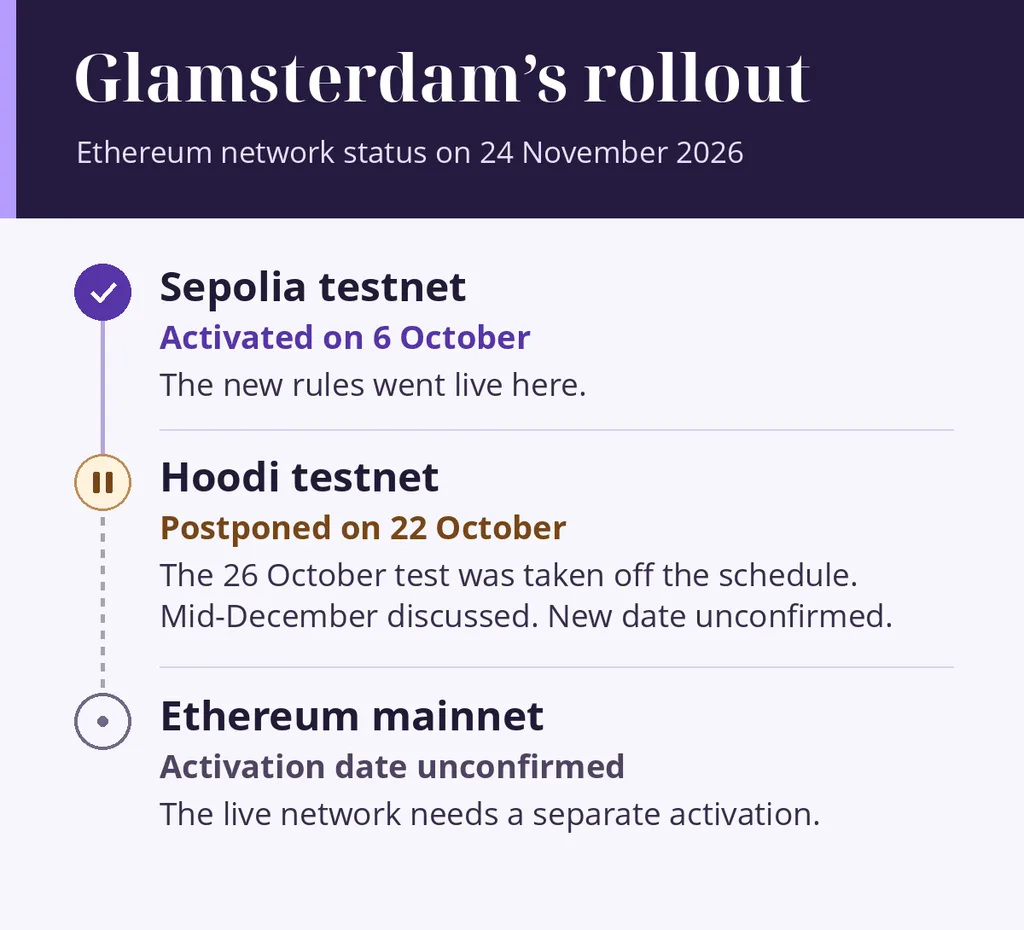
Glamsterdam activated on Sepolia on 6 October. Sepolia is a public test network where developers can try proposed changes to Ethereum’s software. A further activation on Hoodi was scheduled for 26 October. Developers put the Hoodi test on hold on 22 October after researchers found that the proposed gas rules could change how some programs already running on Ethereum behave.
Ethereum recommends Sepolia for testing applications and the tools that interact with them. Hoodi serves infrastructure providers, including teams that test the software that validators use to agree on blocks. Application developers can check how their code behaves under the proposed rules, while operators can test the software they use to keep the network running.
Why Developers Put Hoodi on Hold
The October review centred on gas, the unit Ethereum uses to account for the work involved in processing a transaction. Ethereum’s state is the record that carries forward from one block to the next. It includes account balances and data saved by smart contracts, the programs that run on the network. Two Glamsterdam proposals, labelled EIP-8037 and EIP-8038 in the specification, would change the gas charged for creating data the network has to keep and for some operations involving data already stored. The aim is to let Ethereum process more work while accounting for the demands that persistent data places on the network.
The Hoodi plan paired the new rules with a proposal to raise the test network’s block gas limit to 200 million. The limit caps the gas that transactions in a block can use. The rules assign a gas cost to individual operations within that limit. The postponement took both changes off Hoodi’s October schedule.
Some smart contracts direct part of a transaction to another contract and give that step a fixed gas allowance. The amount of work covered by that allowance depends on the network’s rules. When an operation uses more gas under those rules, the same allowance can cover less work. The code can stay the same even as a step it depends on fails.
The distinction between an app and its contracts shapes the repairs available. Updating the interface that people use to reach a contract leaves the contract’s own gas allowance in place. Where the allowance is built into code that cannot be changed in place, addressing it can involve replacing a contract, rather than updating the app around it. Reviewers had to examine the contracts already running on Ethereum, as well as the software that would enforce the new rules.
At the 19 November developer meeting, developers reported that the Ethereum Foundation and two security firms had contacted at least 50 companies with software the proposals could affect. Most of the teams maintaining software that executes Ethereum transactions favoured keeping the proposed gas rules. They had yet to settle the decision. Retaining the rules would leave affected application teams to adapt where they could. Developers were aiming for mid-December fixes in the most serious cases they had identified.
One option under discussion was to change when gas could be returned to a transaction’s remaining allowance. That could resolve some of the problems auditors had identified. It could also affect other contracts that rely on getting gas back before the transaction finishes. A revision would give the teams writing Ethereum software another version to implement, and the auditors another set of interactions to check before the upgrade moved on.
What a Mainnet Announcement Would Confirm
At the same meeting, developers discussed a window in mid-December for the Hoodi rehearsal, subject to confirmation. As of 24 November, both Hoodi’s replacement date and the mainnet activation date remained unconfirmed. A confirmed Hoodi date would give testnet operators a point at which to run the next rehearsal. A mainnet date would schedule the switch for the network running existing applications.
For application teams, a mainnet date would set a deadline for testing their software against the rules that will apply to live transactions. Final rules give them a specification to test against. They need to know which operations will be charged differently, where their contracts rely on current charges, and which fixes they can deploy ahead of the switch.
The Hoodi pause gave developers time to investigate that existing code while the new rules were still confined to testing. When mainnet switches, existing contracts and software written for the upgrade will start running under the same revised gas schedule. Working out where those older contracts depend on the previous charges is part of preparing the network for that shared switch.