Key takeaways
- Google's Willow chip beats classical coordination game limits
- Researchers demonstrate quantum advantages across 105 qubits
- Breakthrough introduces new tests for quantum hardware errors
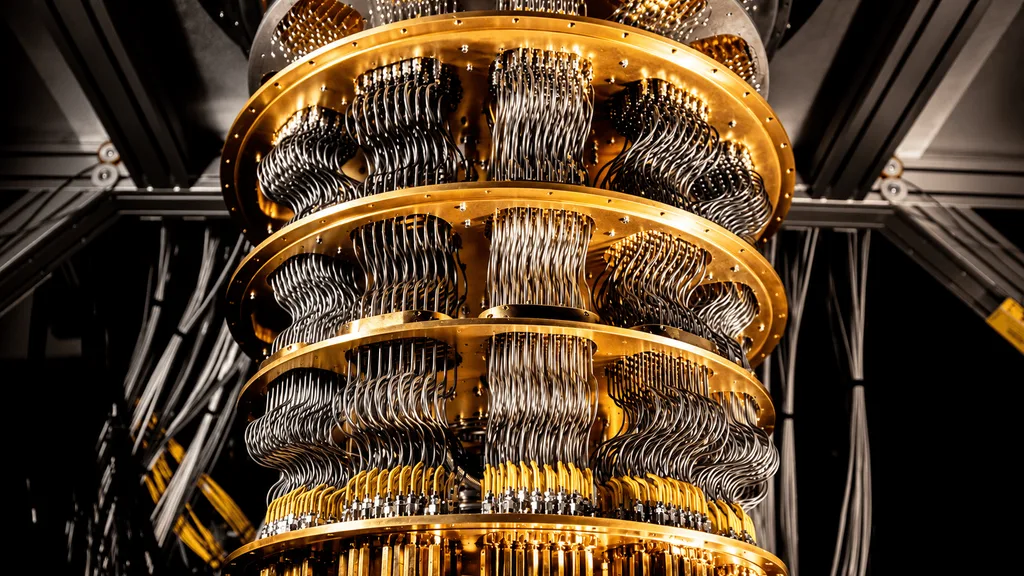
Google has demonstrated a new quantum computing breakthrough, with its Willow processor winning a specialized coordination game 98.3% of the time, exceeding the theoretical 88.9% success limit achievable through classical strategies.
The results, announced November 19 and published in Science, provide experimental evidence that quantum hardware can solve certain structured problems more successfully than conventional approaches operating under the same rules.
According to Google Quantum AI's research announcement, scientists also demonstrated advantages in separate experiments involving up to 105 qubits, potentially advancing efforts to build more reliable quantum processors.
The findings extend Google's earlier Willow error-reduction breakthrough, which demonstrated major improvements in quantum hardware performance.
Google Willow Chip Beats Classical Limit With 98.3% Success
The experiment involved a mathematical challenge known as the magic-square game.
Two participants receive separate instructions to fill a three-by-three grid using positive and negative values. They must satisfy mathematical rules while agreeing on their shared grid position, without communicating during the game.
Under classical rules, even the best possible strategy can succeed only eight times out of nine, equivalent to approximately 88.89%.
Google's researchers instead used four qubits arranged into two entangled pairs, allowing quantum correlations to produce more consistent answers.
After testing each of the game's nine configurations 100,000 times, Willow achieved a 98.30% success rate, with a reported uncertainty of 0.01 percentage points.
The result demonstrates quantum contextuality, a property under which measurement outcomes cannot always be explained by values predetermined independently of their measurement context.
Google Demonstrates Quantum Advantages With Up to 105 Qubits
Google also tested whether the same underlying quantum behavior could remain useful in larger systems.
In one experiment, researchers coordinated up to 71 qubits in a multiplayer parity game, maintaining performance above the corresponding classical limits.
Another experiment ran a shallow-circuit algorithm involving up to 105 qubits, achieving success probabilities above a specified classical bound of 50%.
These results add to advances across the industry, including IBM's earlier 120-qubit entanglement milestone.
Researchers also found that these experiments revealed subtle hardware errors that conventional benchmarking techniques sometimes miss.
This could help developers assess quantum processors designed for future chemistry and materials-science applications.
What Does Google's Quantum Breakthrough Mean for Bitcoin and Stocks?
The findings strengthen Google's position in an increasingly competitive industry that includes IBM and emerging quantum computing stocks.
However, the research does not establish an immediate commercial revenue opportunity for Alphabet or demonstrate that Willow can outperform classical computers across general workloads.
The announcement also arrives amid ongoing concerns about the long-term security of cryptocurrency networks.
Recent Bitcoin hardware-wallet research has explored how existing security systems might respond to future quantum threats.
Meanwhile, developers are examining post-quantum security for XRP Ledger, reflecting preparations for advances in cryptographic attacks.