Key takeaways
- Taiwan restricts short selling after historic market collapse
- TAIEX falls 28.5% from its October record high
- New margin requirements take effect Monday, November 23
Taiwan is tightening short-selling restrictions for the third time this month after its technology-heavy stock market collapsed nearly 28.5% from October's record high, as the global artificial intelligence selloff continues battering semiconductor stocks.
The Financial Supervisory Commission (FSC) announced additional measures on Saturday, November 21, after the TAIEX plunged 6.23% on Friday to close at 36,033.29 points, its lowest closing level in nearly seven months.
The benchmark had reached an intraday record of 49,968.92 on October 6 before falling to 35,738.68 during Friday's session, representing a 28.48% peak-to-trough decline.
The latest intervention follows an Asian stock market crash that spread across Taiwan, Japan and South Korea despite strong earnings from major technology companies.
Taiwan Expands Short-Selling Restrictions After 28% Stock Market Crash
According to Taiwan's Financial Supervisory Commission, the latest restrictions will prohibit certain short sales of stocks that declined during the previous trading session.
The rule replaces an earlier threshold introduced November 19, which applied to shares that had fallen at least 3.5% in one day.
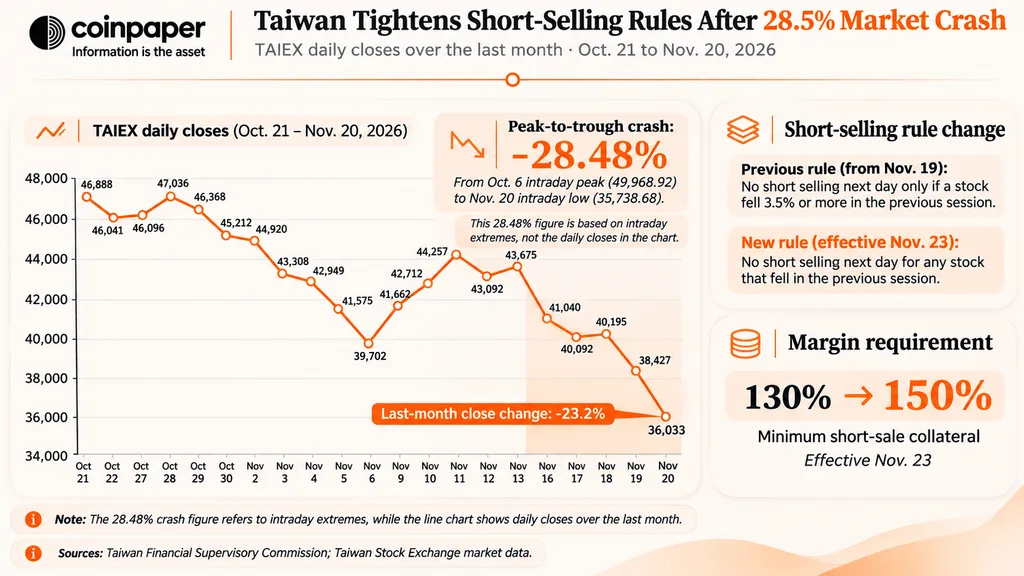
The regulator also increased minimum collateral requirements for short-selling positions from 130% to 150%, making bearish leveraged trades more capital-intensive.
In addition, authorities suspended new applications to issue listed put warrants and urged financial institutions to limit securities lending.
Earlier restrictions had already reduced daily borrowed-share short-selling limits, reflecting increasingly aggressive attempts to stabilize Taiwan's equity market.
However, the measures do not prohibit investors from selling shares they own, and they do not guarantee that stock prices will recover.
TSMC and Nvidia Selloff Spreads Across Asian Semiconductor Stocks
Taiwan's market decline has coincided with a broad retreat from artificial intelligence infrastructure investments.
Taiwan Semiconductor Manufacturing Company (TSMC), a critical supplier of advanced chips to Nvidia, has been particularly exposed to shifts in expectations for AI hardware demand.
During the earlier TSMC stock selloff, shares fell 5.74% in one session as South Korean semiconductor companies also suffered substantial losses.
The latest selling intensified even after Nvidia reported $115.8 billion in quarterly revenue, reflecting investor concerns about whether extraordinary AI infrastructure spending can remain sustainable.
These concerns have also affected Wall Street, where the Nasdaq lost 10% in one week.
The correction highlights the concentration of Taiwan's economy and stock market in the semiconductor supply chain, although falling valuations do not establish that manufacturers have suffered comparable declines in orders or revenue.
Can Taiwan's $15 Billion Stabilization Fund Stop the AI Stock Crash?
Taiwan's National Financial Stabilization Fund, worth NT$500 billion, or approximately $15.18 billion, has been authorized to intervene since November 6.
Authorities are also encouraging companies to repurchase their shares and financial institutions to support market liquidity.
These measures arrive as the broader U.S. stock market correction raises questions about investor confidence in AI-related valuations.