Key takeaways
- Oil prices tumble nearly 4% as Iran diplomacy advances
- OPEC+ keeps December production targets unchanged despite market volatility
- Strait of Hormuz disruptions continue threatening global oil supply
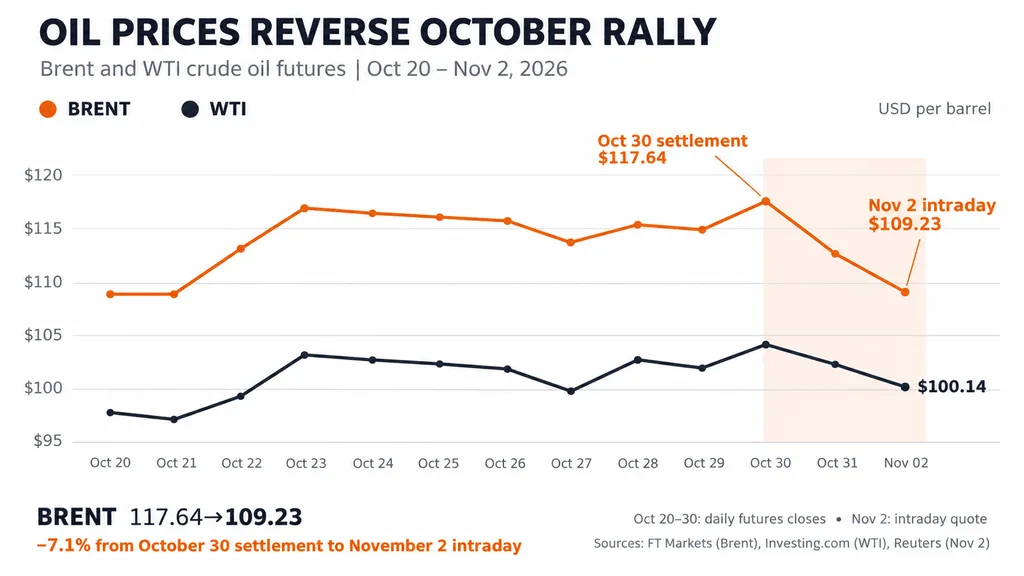
Brent crude futures fell $4.20, or 3.7%, to $109.23 per barrel by 09:00 GMT, while U.S. West Texas Intermediate dropped $3.98, or 3.8%, to $100.14. Subsequent trading briefly pushed WTI below the psychologically important $100 threshold.
According to Reuters, Iranian officials held talks with Qatari mediators over a potential agreement to end the U.S.-Israeli war with Iran, reducing immediate fears of another escalation.
The decline came despite OPEC+'s November 1 decision to maintain December production targets, highlighting how quickly changing geopolitical expectations can influence oil prices without an actual increase in supply.
Brent Falls Toward $109 as Iran Talks Ease Supply Fears
Monday's selloff followed a strong October, when Brent gained 13.6% and WTI climbed 15.2% amid repeated attacks on energy infrastructure and shipping routes.
Brent finished October at a six-month closing high after a tanker was struck in the Strait of Hormuz, intensifying concerns about disruptions to one of the world's most important oil transportation corridors.
The latest diplomatic developments have partially reversed that momentum.
Iranian negotiators left Doha on Sunday, although an official familiar with the discussions said their departure did not indicate a breakdown. Iranian Foreign Minister Abbas Araqchi described consultations with Qatari mediators as continuing.
However, no agreement has been announced, and the possibility of renewed military escalation remains.
The recent oil price rally followed Houthi claims of an attack on Saudi Arabia's Ras Tanura refinery, while a separate tanker incident reinforced concerns about Gulf shipping.
OPEC+ Freezes December Output as Supply Risks Persist
Seven OPEC+ producers, including Saudi Arabia and Russia, agreed on November 1 to maintain their existing production targets for December.
The decision confirmed expectations outlined in an earlier OPEC+ production outlook, when the group was already signaling reluctance to change quotas amid Middle East disruptions.
However, production targets are not equivalent to the volume of oil physically reaching international markets.
OPEC output remained more than 3 million barrels per day below prewar levels in September, while exporters continued redirecting shipments around disrupted routes.
Shipments through alternative terminals in Fujairah and Oman have reportedly increased substantially, but transportation constraints remain significant.
Earlier Goldman Sachs research also highlighted the gap between recovering Gulf exports and prewar shipping volumes.
Meanwhile, OPEC previously reduced its 2026 demand growth forecast, introducing another challenge for crude prices if physical supply gradually improves.
Could Oil Fall Below $100 as Diplomacy Continues?
Oil's next direction will depend heavily on whether negotiations produce measurable progress toward reopening the Strait of Hormuz.
A durable agreement could reduce shipping risks and put additional pressure on Brent, potentially bringing $105 and eventually $100 into focus.
However, renewed attacks could quickly reverse Monday's decline.
Goldman Sachs recently raised its oil forecasts and warned that Brent could reach $140 in 2027 if Gulf production remains severely constrained. That scenario is conditional, not the bank's guaranteed price forecast.
The market is also entering a politically sensitive week ahead of the November 3 U.S. midterm elections, with investors watching for changes in Washington's approach to Iran.
Previous oil supply disruptions demonstrate how vulnerable alternative export routes remain.