Key takeaways
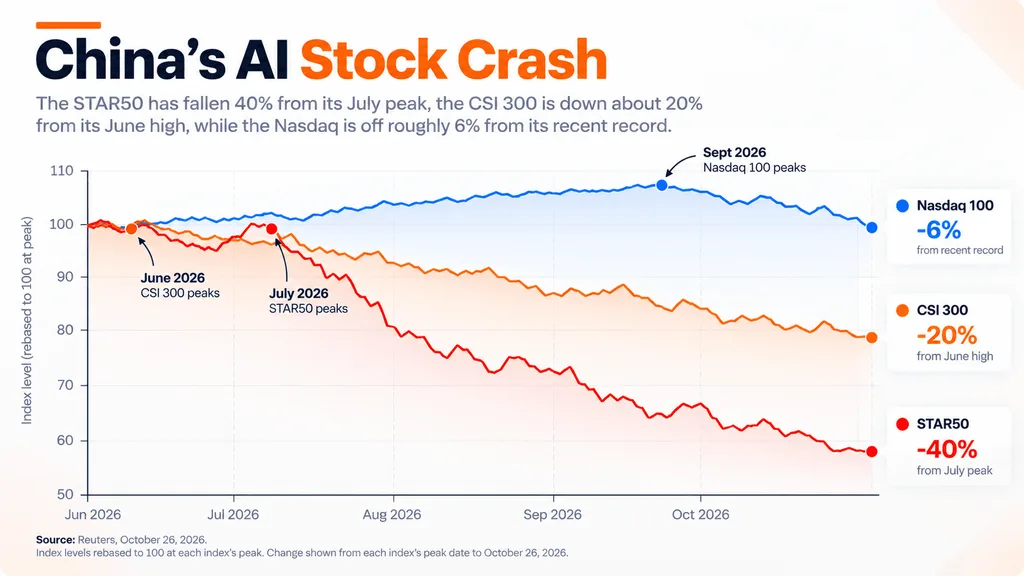
- China's STAR50 index loses 40% in four months
- Nvidia faces growing Chinese competition despite strong global demand
- Elevated AI valuations leave investors exposed to further losses
China spent two years turning artificial intelligence into one of its hottest investment themes. Now that enthusiasm has produced a $480 billion reckoning, with the country's technology-heavy STAR50 index losing approximately 40% in less than four months.
The decline, documented in an October 26 Reuters analysis, comes as investors question AI demand, corporate profitability and the extraordinary valuations assigned to Chinese semiconductor and robotics companies.
The selloff has also helped push the broader CSI 300 into bear-market territory, with the blue-chip benchmark falling approximately 20% from its June peak.
But the downturn creates an unusual contradiction for Nvidia: China's domestic AI companies are losing market value while their technology is becoming an increasingly serious competitive challenge.
China's AI Boom Turns Into a $480 Billion Collapse
China's technology rally accelerated as investors bet on government support, domestic chip manufacturing and the commercial potential of artificial intelligence.
At the height of the boom, AI-related shares accounted for approximately 42% of Chinese equity-market capitalization and 57% of trading turnover across mainland and Hong Kong markets, according to Goldman Sachs data cited by Reuters.
That concentration made the market especially vulnerable when investor expectations changed.
The losses have been dramatic among companies that previously attracted enormous speculative demand. Robotics manufacturer Unitree, whose August IPO produced a 460% first-day gain, has subsequently lost roughly half its value.
Chinese chip designers MetaX and Moore Threads have also surrendered around half their value since July, while memory manufacturer CXMT has declined substantially from its highs following a spectacular trading debut.
The surprise is that valuations remain expensive even after those losses.
Reuters estimates the STAR50 trades at approximately 100 times trailing earnings, compared with roughly 30 times for the Nasdaq 100. Falling stock prices have therefore not eliminated expectations of extraordinary future growth.
Nvidia's China Market Share Falls as Huawei Gains Ground
The Chinese selloff does not necessarily mean Nvidia's global AI business is weakening.
However, a separate development reveals how the competitive landscape is changing.
According to IDC research reported by Reuters on October 13, Nvidia's share of China's data-center AI accelerator market declined to 34% during the first half of 2026. Shipments fell 44% year over year to approximately 678,000 units.
U.S. export controls have restricted Nvidia's access to Chinese customers, while Beijing has encouraged domestic alternatives from Huawei and other semiconductor developers.
Even when Washington approved limited chip shipments, Nvidia struggled to convert licenses into sales.
Huawei and other suppliers have gained opportunities to develop domestic hardware and software ecosystems, although catching Nvidia in performance, production capacity and developer support remains a separate challenge.
Earlier reports that Beijing might reopen some Nvidia purchases demonstrate why the market remains commercially significant, even as local chipmakers expand.
Could China's AI Crash Spread to Nvidia Stock?
The $480 billion loss reflects falling market valuations, not an equivalent amount of cash leaving companies or AI infrastructure projects.
But lower valuations can make raising equity more difficult, particularly for startups planning expensive chip development and computing expansion.
Meanwhile, American semiconductor companies have already experienced their own AI stock selloff, although China's correction has been substantially deeper.