Key takeaways
- Ripple wants clearer rules for ending investment contracts
- Proposed Form TR should not become mandatory evidence
- Exchanges could gain protections when relying on filings
Ripple is asking the U.S. Securities and Exchange Commission to change how cryptocurrency projects establish that their tokens are no longer associated with securities investment contracts, arguing that the proposed rules could create new uncertainty without additional protections.
In an October 20 comment letter, Ripple supported the SEC's Regulation Crypto Assets proposal while requesting amendments to Rule 400, which would establish a process for certain investment contracts to cease being treated as securities.
The company argues that a token should not remain tied to securities-law obligations indefinitely simply because its original issuer once promised to develop or improve a project.
Ripple Wants SEC to Clarify When Investment Contracts End
The SEC's proposed framework distinguishes a cryptocurrency from the investment contract through which it may have been sold.
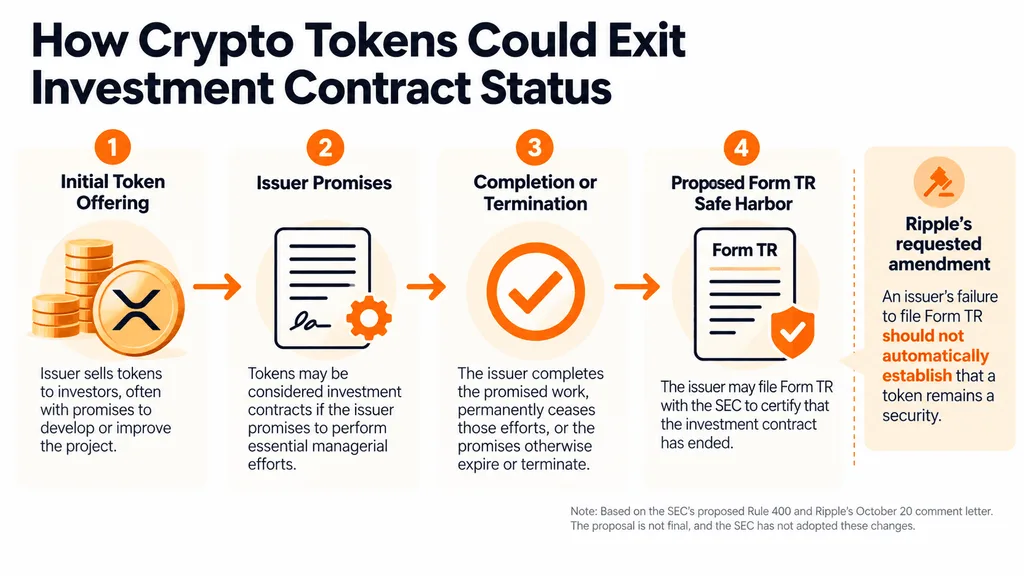
Under proposed Rule 400, qualifying issuers could file Form TR after completing or permanently ceasing the essential managerial efforts they previously promised investors.
Ripple supports the mechanism but wants the SEC to recognize that investment contracts can also end when promises expire, are abandoned or otherwise terminate.
The distinction matters because legal obligations may cease even when a blockchain's developers remain active.
Ripple previously challenged the SEC's reliance on decentralization tests, arguing that specific contractual commitments provide a more objective measure.
The company's latest submission also requests a no-presumption clause protecting issuers that choose not to submit Form TR.
Without that safeguard, Ripple fears that a future regulator could treat the absence of a filing as evidence that a token remains associated with an investment contract.
Why Ripple Wants More Protection for Crypto Exchanges
Ripple's proposals extend beyond token issuers.
The company argues that cryptocurrency exchanges, brokers and dealers need clearer rules allowing them to rely on publicly filed Form TR certifications when deciding whether to support trading.
Under Ripple's suggested approach, an intermediary acting in good faith should not face retroactive regulatory consequences simply because the SEC later questions an issuer's certification.
Ripple also wants adjustments to proposed Rule 500, which addresses federal preemption for certain secondary-market transactions.
As drafted, some conditions depend on an issuer remaining current with regulatory filings, potentially exposing intermediaries to compliance risks they cannot independently control.
These questions follow the SEC's broader 2026 crypto classification guidance, which distinguished digital assets from investment contracts associated with particular transactions.
What the Proposed Changes Could Mean for XRP
Ripple's recommendations draw heavily on its previous legal dispute with the SEC.
The company's XRP lawsuit concluded in 2025 after both sides dismissed their appeals, leaving important distinctions between Ripple's institutional sales and exchange transactions intact.
Its latest filing seeks rules that apply more broadly than the circumstances of that individual case.
Ripple also requested regulatory clarification earlier this year concerning XRP and other major cryptocurrencies.
Meanwhile, lawmakers have considered similar questions through the CLARITY Act, reflecting continuing efforts to clarify digital-asset oversight.
The SEC's Regulation Crypto Assets proposal would separately permit qualifying offerings of up to $5 million over four years or $75 million during a 12-month period, subject to disclosure and investor-protection requirements.
Ripple previously outlined its support for those exemptions, while emphasizing that regulatory clarity should not depend on years of litigation.