
Key takeaways
- Russian diesel tanker signals New York after Trump–Putin agreement
- First shipment carries 40,000 tons, with arrival still uncertain
- Additional Russian supply may offer limited U.S. fuel relief
A tanker carrying 40,000 metric tons of Russian diesel is heading across the Atlantic after President Donald Trump's agreement with Vladimir Putin reopened a trade route restricted since 2022, marking the first major physical test of Washington's new energy policy.
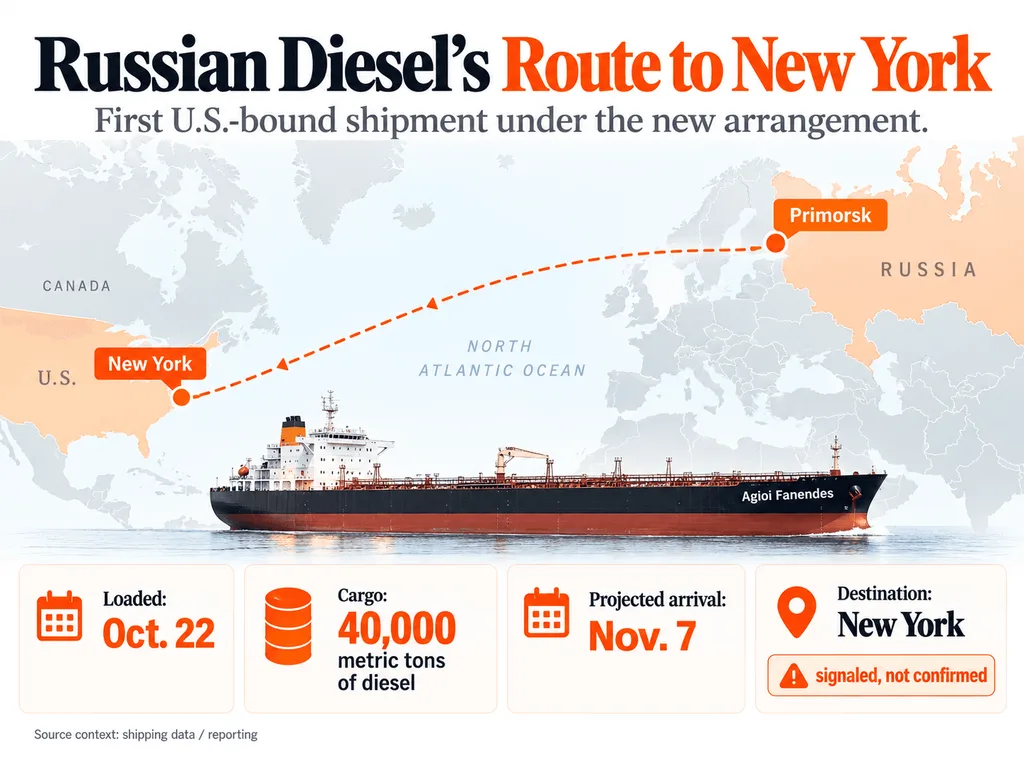
The Malta-flagged Agioi Fanendes loaded ultra-low-sulfur diesel at Russia's Baltic port of Primorsk on October 22 and initially signaled New York, with an estimated arrival on November 7.
According to Reuters and LSEG shipping data, the cargo represents one of the first U.S.-bound Russian diesel shipments under the new arrangement. However, its final discharge port remains unconfirmed, and the buyer and seller have not been identified.
Trump-Putin Deal Reopens Russian Diesel Trade
The shipment follows Trump's October 9 announcement that Russia would resume larger diesel exports to international markets, including the United States, as Washington attempts to reduce elevated fuel costs.
Trump outlined an initial 300,000 metric tons of additional supply, followed by 500,000 tons in November and another 1 million tons afterward. These figures represent announced commitments rather than completed deliveries.
The U.S. Treasury subsequently issued General License 135, temporarily authorizing certain transactions involving Russian-origin diesel through April 7, 2027.
That decision expanded the earlier sanctions relief discussed as Washington sought additional energy supplies. It does not remove every Russia-related restriction.
Trump also waived additional penalties targeting Russian energy trade, reversing part of the pressure created by legislation signed in September.
Can Russian Diesel Actually Lower U.S. Fuel Prices?
The first shipment amounts to approximately 300,000 barrels of diesel, or about 7% of the four million barrels consumed daily across the United States.
That relatively small volume raises questions about whether the agreement can meaningfully reduce prices, particularly before the November 3 midterm elections.
An earlier IEA warning highlighted the scale of the shortage, with global diesel exports running roughly 700,000 barrels per day below year-earlier levels in September.
Wholesale diesel prices also exceeded $200 per barrel in several major markets, reflecting disrupted refining operations and depleted inventories.

Russia faces its own production constraints after repeated Ukrainian drone attacks on refineries reduced output and contributed to domestic fuel shortages.
Although Moscow says exports could recover to 3–3.5 million metric tons monthly by year-end, achieving those volumes depends on refinery operations, shipping logistics and commercial arrangements.
Ukraine War Complicates Trump's Energy Strategy
The new shipments have created a political contradiction: Washington is allowing certain Russian fuel purchases while diplomatic negotiations continue over Moscow's war in Ukraine.
Ukrainian President Volodymyr Zelenskyy has criticized the agreement, warning that renewed energy revenue could benefit Russia during the conflict.
The controversy follows Trump's disputed energy ceasefire announcement, which Kyiv said had not been finalized.
It also contrasts with Washington's earlier sanctions legislation, designed to restrict Russian energy revenues and increase pressure on buyers.