Key takeaways
- XRPL bypassed standard voting for critical security fix
- Over 80% of trusted validators upgraded immediately
- Emergency response raises questions about decentralized governance
XRP Ledger developers are defending an extraordinary security decision after deploying a critical protocol fix without waiting for the network's standard two-week validator approval process.
The emergency update, released September 25, addressed an 11-year-old vulnerability that could have allowed attackers to create spendable XRP beyond the cryptocurrency's intended supply limit. Although investigators found no evidence of exploitation, the method used to eliminate the threat has sparked debate about how decentralized networks should respond to emergencies.
Why XRP Ledger Skipped Its Two-Week Validator Vote
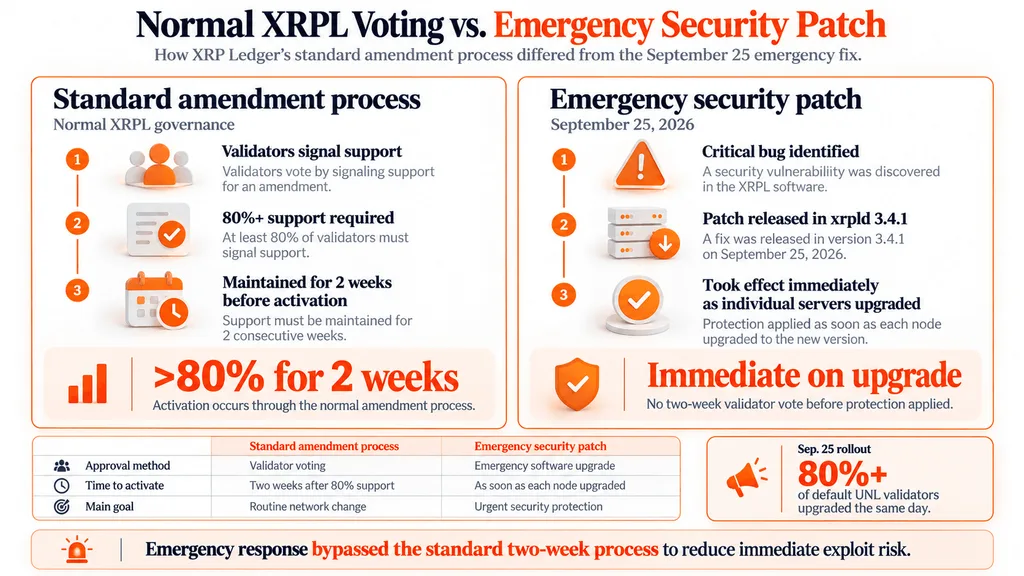
Under the normal XRPL governance framework, changes affecting transaction processing must receive support from more than 80% of trusted validators for two consecutive weeks before activation.
The September security patch followed a different procedure.
According to the official vulnerability report, the fix became effective immediately on each server after upgrading to xrpld 3.4.1, rather than activating simultaneously through an approved amendment.
Developers said the severity of the XRP supply vulnerability made the normal process too dangerous. Publishing the patch while leaving the flaw exploitable during an extended voting period could have given attackers enough information to reproduce the exploit.
The underlying problem involved an integer overflow in the payment engine. Specially constructed transactions could have caused the system to credit more XRP than the sender actually paid, potentially creating new tokens.
Researchers traced the vulnerable code to 2015, although they found no evidence that it had been exploited on a public network.
Emergency Fix Introduced a Temporary Consensus Risk
The decision was not without technical consequences.
Normally, amendments activate simultaneously across compatible servers, ensuring validators apply identical transaction rules. The emergency update instead created a temporary period when upgraded servers would reject certain malicious transactions while older versions might still accept them.
That disagreement could theoretically have interrupted ledger validation if attackers attempted to exploit the vulnerability before enough validators upgraded.
However, the rapid rollout reduced that exposure. More than 80% of operators on the default Unique Node List had installed version 3.4.1 by September 25, according to the development team's disclosure.
The response differed from the separate Batch security fix, which followed the normal amendment procedure and activated on October 9.
| Security Measure | XRP Overflow Fix | Batch Wrapper Fix |
|---|---|---|
| Released | September 25 | September 25 |
| Activation method | Immediate upon server upgrade | Validator-approved amendment |
| Mainnet activation | During server upgrades | October 9 |
| Key threat | Unauthorized XRP creation | Potential consensus disruption |
Source: XRPL vulnerability disclosure, October 9, 2026.
Does the Emergency Patch Challenge XRP Ledger Decentralization?
The incident has prompted questions about how much authority developers and validator operators should exercise during severe network emergencies.
Criticism has focused partly on the temporary distribution of software before the security-sensitive source code was publicly released. Supporters argue that immediate coordination was necessary to prevent attackers from exploiting a disclosed weakness.
The XRPL Foundation has rejected suggestions that operators were forced to install the update, emphasizing that validators made their own upgrade decisions.
The debate also comes as upcoming XRPL lending upgrades continue moving through the ordinary voting process, demonstrating that routine protocol changes still require sustained validator support.
Developers maintain that bypassing amendments should remain reserved for exceptionally severe security threats, rather than becoming a standard alternative to network governance.
For XRP holders, the immediate concern has been addressed: the vulnerability was patched, and investigators reported no known exploitation. The longer-term question is how XRPL can maintain decentralized decision-making while responding quickly enough to future critical threats.