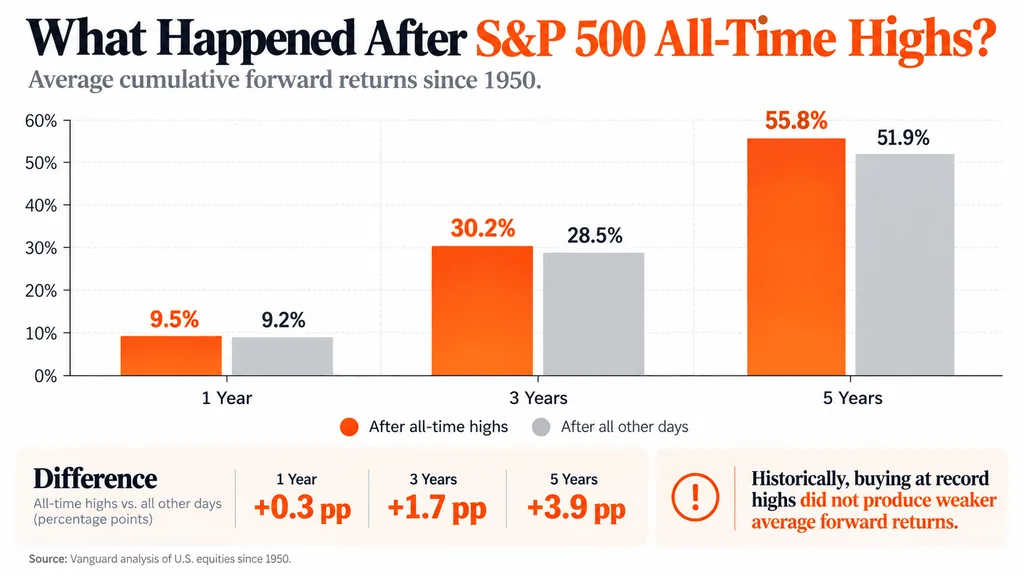
A Vanguard analysis covering U.S. equities since 1950 found that investing on all-time-high days was followed by an average 9.5% cumulative return after one year, 30.2% after three years and 55.8% after five years.
Those figures are particularly relevant after the S&P 500 and Nasdaq reached fresh records, with the benchmark climbing above 7,800 despite unusually high Treasury yields and continued uncertainty over inflation.
New Highs Have Not Historically Meant Stocks Are Expensive Enough to Fall
The counterintuitive part is what happens when record highs are compared with every other trading day.
Vanguard found average one-year returns of 9.5% after an all-time high versus 9.2% after other days. Over three years, the comparison was 30.2% versus 28.5%, while five-year returns were 55.8% versus 51.9%.
In other words, buying when the market looked historically expensive did not produce weaker average results over those horizons.
The Current Rally Has One Important Weakness
Historical averages do not remove the risks surrounding today's market.
The current S&P 500 rally remains unusually concentrated. More than 70% of index constituents are still at least 10% below their own recent highs, even while the headline index trades at a record.
The market-cap-weighted S&P 500 has also substantially outperformed its equal-weight counterpart, showing how heavily the index still depends on its largest companies.
AI-linked mega-caps are doing much of the work. The 10 largest S&P 500 companies recently accounted for roughly 38% of the index, leaving passive investors with significant AI stock exposure.
That concentration matters even more with the 10-year Treasury yield above 5%.
Longer-Term Data Adds an Important Warning
The same Vanguard study becomes less bullish over longer periods.
Average 10-year returns following record highs were 108.8%, versus 121.8% after other days. Over 20 years, the gap widened to 243.1% versus 348.8%.
So the historical lesson is narrower than “stocks always rise after records.”
All-time highs have generally not been reliable short- or medium-term sell signals. But valuations, earnings, market concentration and the pressure from elevated Treasury yields still matter enormously for what happens next.