In This Article
The crypto market is entering the middle of August in better shape than it was at the beginning of July, but investors still have plenty of reasons to stay cautious.
Bitcoin is trading around $63,900 after falling close to $59,000 last month. Institutional demand has also improved, with US spot Bitcoin and Ethereum ETFs attracting roughly $1.1 billion combined during the first full week of August.
However, the recovery is far from secure. Strategy recently sold another 1,690 BTC worth $108.6 million, extending a run of Bitcoin sales, while investors are waiting for the July US Consumer Price Index report on Aug. 12.
Against that backdrop, some cryptocurrencies have stronger catalysts than others heading through the rest of August.
Bitcoin (BTC)
Bitcoin is probably the most important cryptocurrency to watch in August 2026. BTC is currently trading around $63,900 after recovering from the sub-$60,000 levels seen earlier this summer.

BTC’s price action over the past month (Source: CoinCodex)
The biggest positive development is the return of institutional ETF demand. US spot Bitcoin and Ethereum ETFs attracted approximately $1.1 billion during the first full week of August, with Bitcoin products accounting for roughly $850 million of those inflows.
Bitcoin is still crypto's primary institutional liquidity asset, which means improving market sentiment will likely benefit BTC before smaller cryptocurrencies.
There are risks, however.
Strategy sold 1,690 BTC between Aug. 3 and Aug. 9 for $108.6 million. This was the company's fourth consecutive week of Bitcoin sales, bringing its total over that period to 6,916 BTC.
Macroeconomic conditions could also dominate Bitcoin's price throughout August. The US Bureau of Labor Statistics is scheduled to release July CPI data on Aug. 12, making inflation and changing interest-rate expectations major short-term catalysts.
Despite those risks, Bitcoin's liquidity, ETF access and institutional position keep it at the top of the August list.
Ethereum (ETH)
Ethereum is one of the strongest long-term infrastructure investments in crypto, but its August investment case looks slightly different from July. ETH is currently trading around $1,873.

ETH’s price action over the past month (Source: CoinCodex)
One of the more important developments for Ethereum in 2026 has been the expansion of regulated institutional products beyond simple ETH price exposure.
BlackRock's iShares Staked Ethereum Trust ETF, or ETHB, now gives investors exposure to both Ethereum's price and staking rewards through a traditional brokerage product. BlackRock describes the fund as seeking to reflect the performance of Ether while also earning rewards from staking part of the trust's ETH.
Ethereum investment products also participated in the early-August rebound in crypto ETF demand, with spot ETH ETFs attracting roughly $244 million during the first full week of the month.
One important correction from the July outlook is the timing of Ethereum's Glamsterdam upgrade. Ethereum's official roadmap now lists Glamsterdam for Q4 2026, rather than as an imminent August catalyst.
The upgrade is expected to introduce major changes including enshrined proposer-builder separation and block-level access lists as part of Ethereum's longer-term scaling roadmap.
For August, ETH's price is therefore more likely to be influenced by ETF flows, institutional staking demand, broader DeFi activity and Bitcoin's direction than by Glamsterdam itself.
Solana (SOL)
Solana is one of the most interesting Layer-1 investments for August because one of its most important technical upgrades is moving closer to deployment. SOL is currently trading around $76.
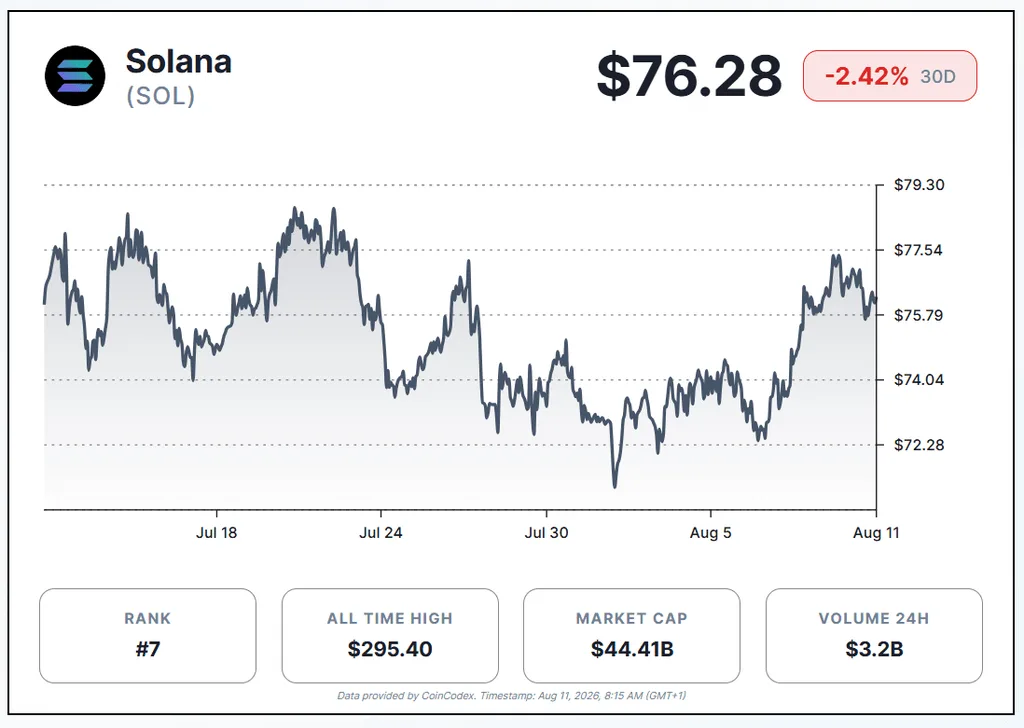
SOL’s price action over the past month (Source: CoinCodex)
The major catalyst is Alpenglow, Solana's proposed new consensus architecture. Solana said in July that Alpenswitch was expected to reach testnet in July and mainnet in August. The network's Aug. 6 developer update showed that work is continuing, with both Agave and Firedancer moving toward QUIC datagrams for Alpenglow messages to reduce connection overhead and improve performance.
That gives SOL something many large-cap cryptocurrencies do not currently have: a major protocol-level catalyst unfolding during August.
The risk is execution. Large consensus changes can experience delays or technical problems, and SOL is still a higher-beta asset that tends to move more aggressively than Bitcoin when market sentiment deteriorates.
Still, if Alpenglow deployment continues progressing and the market stabilizes, Solana could be one of the strongest large-cap altcoins to watch this month.
XRP (XRP)
XRP stays on the August list because Ripple continues moving deeper into regulated institutional crypto infrastructure. XRP is currently trading around $1.02.

XRP’s price action over the past month (Source: CoinCodex)
One of the biggest recent developments came on Aug. 5, when Ripple confirmed that it received Crypto Asset Service Provider authorization from Luxembourg's financial regulator.
The authorization makes Ripple fully compliant under the European Union's Markets in Crypto-Assets Regulation, or MiCA, and gives the company a stronger regulatory base from which to expand digital asset services across Europe. Ripple says it now holds more than 75 regulatory licenses globally.
Ripple also continued building around RLUSD and institutional tokenization. In July, the company introduced Ripple Mint, an institutional platform that is designed to allow businesses to mint, redeem and manage stablecoins including RLUSD. Ripple is simultaneously developing lending, payments and tokenization infrastructure around the XRP Ledger.
That does not guarantee that every expansion of Ripple's business will translate directly into demand for XRP. However, growing institutional use of XRPL, stablecoins, tokenized assets and regulated crypto infrastructure strengthens the broader ecosystem around the token.
Hyperliquid (HYPE)
Hyperliquid is one of the higher-risk picks, and HYPE is currently trading around $55.24.

HYPE price action over the past month (Source: CoinCodex)
The investment case comes from Hyperliquid's growing position in on-chain trading and its impressive product development.
A particularly important development is HIP-3, which allows builders to permissionlessly deploy perpetual markets on Hyperliquid. This could expand the range of markets available on the protocol and turn Hyperliquid into infrastructure that other trading applications can build on rather than simply a single decentralized exchange.
Hyperliquid has also been rolling out portfolio margin. Its documentation was updated on Aug. 1 and describes a system that allows traders to manage spot and perpetual exposure more efficiently in a unified portfolio.
The protocol's account abstraction documentation now lists HYPE, BTC, USDC and USDT among the eligible assets supported by its most capital-efficient portfolio margin mode. HYPE therefore has several potential August catalysts tied directly to increasing trading functionality and capital efficiency.
However, this is also one of the riskiest assets on the list. Hyperliquid operates in the extremely competitive perpetual futures market, and HYPE is considerably more exposed to changes in speculative trading activity than Bitcoin or Ethereum.
Chainlink (LINK)
Chainlink remains on the list because its institutional adoption story has continued strengthening. LINK is currently trading around $8.30.

LINK piece action over the past month (Source: CoinCodex)
One of the biggest recent developments came from BitGo. Chainlink said on Aug. 4 that BitGo is migrating more than $7.7 billion in Wrapped Bitcoin to Chainlink's Cross-Chain Interoperability Protocol, or CCIP, while also selecting CCIP as the cross-chain infrastructure for future BitGo-issued assets.
That migration is part of a much larger trend. Chainlink says approximately $15 billion in value associated with protocols and assets has been moving toward its infrastructure after a series of migrations from competing cross-chain systems. The list includes BitGo, Kraken, KelpDAO, Lombard, Solv Protocol, Mantle and other projects.
This strengthens LINK's investment case as an infrastructure play on several crypto trends at once: DeFi, tokenization, cross-chain communication and institutional blockchain adoption.
Ondo Finance (ONDO)
Ondo Finance remains one of the strongest pure-play investments in the real-world asset and tokenization sector. ONDO is currently trading around $0.34.

ONDO price action over the past month (Source: CoinCodex)
The project has also had several major developments immediately before and during August. On Aug. 4, Ondo launched its USDY tokenized Treasury product on BNB Chain with instant minting and redemption. The integration makes USDY available across an ecosystem that includes PancakeSwap, Trust Wallet, 1inch, Ledger and LayerZero.
That followed the July introduction of Ondo Network, which expands the infrastructure supporting Ondo's broader tokenized-finance ecosystem.
Perhaps more importantly for its longer-term US ambitions, Ondo announced in July that Oasis Pro Markets had secured FINRA authorizations. This allows it to offer a range of tokenized equities and funds to US investors.
Together, these developments strengthen the argument that Ondo is moving beyond simply offering tokenized Treasuries and toward building a broader on-chain capital markets platform.
Aave (AAVE)
Aave made it onto the August list because it gives the portfolio exposure to one of DeFi's most established lending protocols. AAVE is currently trading around $89.45.

AAVE’s price action over the past month (Source: CoinCodex)
The most important current catalyst is Aave V4. A new governance proposal is advancing the deployment of Aave V4 on Base, one of the protocol's existing major markets. If the proposal passes its governance stages, Aave V4's new Hub-and-Spoke architecture would expand onto Coinbase's Layer-2 network.
V4 is designed to make Aave's lending infrastructure more modular by separating liquidity hubs from individual lending markets, allowing markets to use different risk configurations without completely fragmenting liquidity.
There is also an important risk investors should not overlook. One of AAVE's strongest tokenomics narratives earlier this year was the DAO's token buyback program. However, AAVE buybacks have been paused since April 19 after the rsETH bridge incident. The DAO said the pause was intended to preserve balance-sheet flexibility while the financial consequences of the incident were being resolved.
That means a resumption of buybacks could become a positive future catalyst, while a prolonged pause removes a source of direct market demand for AAVE.
For August, the investment case rests more heavily on V4 adoption, expansion to networks like Base and continued demand for decentralized lending.
Bottom Line
The eight cryptocurrencies that stand out heading through August 2026 are Bitcoin, Ethereum, Solana, XRP, Hyperliquid, Chainlink, Ondo Finance and Aave.
Bitcoin and Ethereum are still the core institutional assets, particularly as ETF demand shows signs of recovering.
Solana has one of the month's most important technical catalysts through continued Alpenglow development. XRP benefits from Ripple's expanding regulatory and institutional infrastructure, while Chainlink continues accumulating major cross-chain and tokenization integrations.
Ondo is one of the clearest ways to gain exposure to the tokenized real-world asset narrative. Hyperliquid provides higher-risk exposure to decentralized trading infrastructure, while Aave gives investors exposure to the continued evolution of DeFi lending through V4.
August still carries considerable downside risk. The July US CPI report on Aug. 12 could change expectations around monetary policy, Bitcoin is also very sensitive to institutional flows, and weakness in BTC could quickly spill into higher-beta altcoins.
That makes the August market less about blindly buying whichever tokens performed best earlier this year and more about identifying projects with genuine catalysts that can continue attracting users, capital or institutional adoption.
As always, cryptocurrencies remain highly volatile, and investors should research individual assets and consider their own risk tolerance before investing.