
Key takeaways
- Gold retreats toward $3,600 ahead of US inflation data
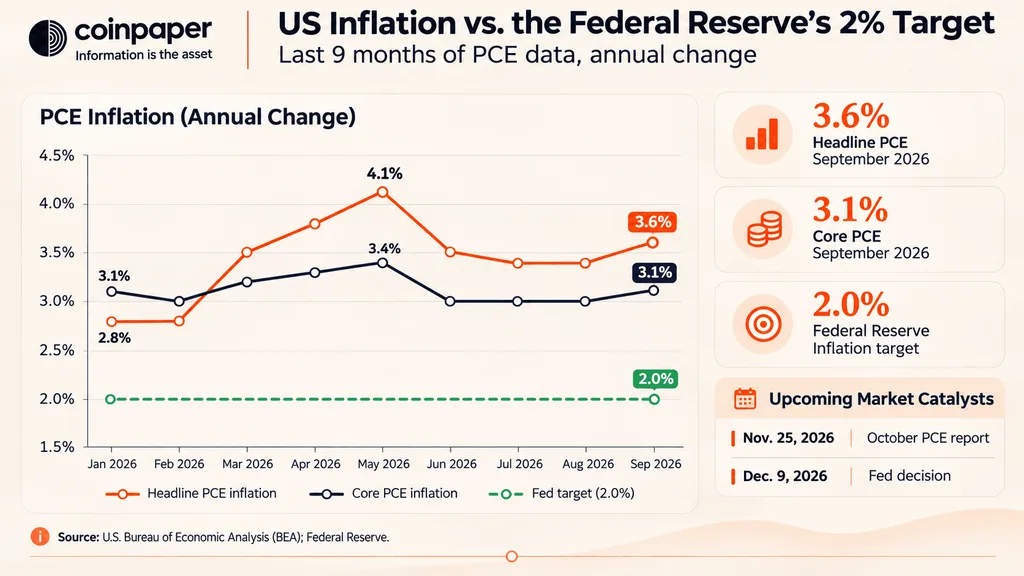
- September PCE inflation reached 3.6%, exceeding the Fed's target
- Hotter inflation could expose gold to another $3,500 test
Gold prices slipped approximately 0.7% to $3,607 on Tuesday, November 24, as investors turned their attention to Wednesday's US inflation report. The decline follows Monday's gold price recovery, which provided temporary relief following a nearly 9% weekly selloff.
US Inflation Data Could Reinforce Fed Rate Hike Expectations
The US Bureau of Economic Analysis will publish its October Personal Consumption Expenditures (PCE) inflation report on November 25 at 8:30 a.m. ET.
According to the previous BEA release, headline PCE inflation reached 3.6% annually in September, while core inflation, excluding food and energy, stood at 3.1%. Monthly headline and core prices increased by 0.5% and 0.3%, respectively.
Both annual measures remain substantially above the Federal Reserve's 2% inflation objective.
A stronger-than-expected October reading could reinforce expectations of additional monetary tightening, particularly ahead of the Federal Reserve's December 8-9 policy meeting.
Higher interest rate expectations have already contributed to the precious metals selloff, as investors reassess the attractiveness of non-yielding assets.
Strong US Dollar and Treasury Yields Pressure Gold
Gold faces additional challenges from the strengthening US dollar, which makes dollar-denominated bullion more expensive for international buyers.
Meanwhile, official US Treasury data shows that the benchmark 10-year yield stood at 4.92% on November 23.
Elevated real yields increase the opportunity cost of holding gold instead of interest-bearing securities. This relationship can explain why gold sometimes declines during periods of accelerating inflation, despite its traditional reputation as an inflation hedge.
In its November 23 market commentary, the World Gold Council identified persistent monetary policy uncertainty, potential inflation surprises and incomplete speculative position adjustments as important near-term risks.
However, the organization assessed gold's overall near-term risks as broadly balanced, suggesting another significant decline is not inevitable.
Gold Price Forecast: Could XAU/USD Fall Below $3,500?
Gold's immediate psychological support stands at $3,600. A sustained breakdown could expose the $3,550 area, which was breached during last week's gold crash.
If Wednesday's inflation report exceeds expectations and Treasury yields move higher, gold could retest $3,500. Such a move would represent a further decline of approximately 3% from current prices.
Conversely, softer inflation could weaken the dollar and reduce expectations of aggressive monetary tightening, potentially allowing gold to recover toward $3,700.
A more sustained rebound would require reclaiming the $3,800 region, which previously marked an important level before gold's decline to a 14-month low.