In This Article
Key takeaways
- Privacy coins conceal sensitive blockchain transaction details
- Zcash uses zero-knowledge proofs for shielded payments
- Monero protects transaction information by default
A privacy coin is a cryptocurrency designed to protect financial information that would otherwise be visible on a public blockchain. Unlike Bitcoin, where transactions can be traced between addresses, privacy-focused cryptocurrencies use cryptography to conceal details such as senders, recipients and payment amounts.
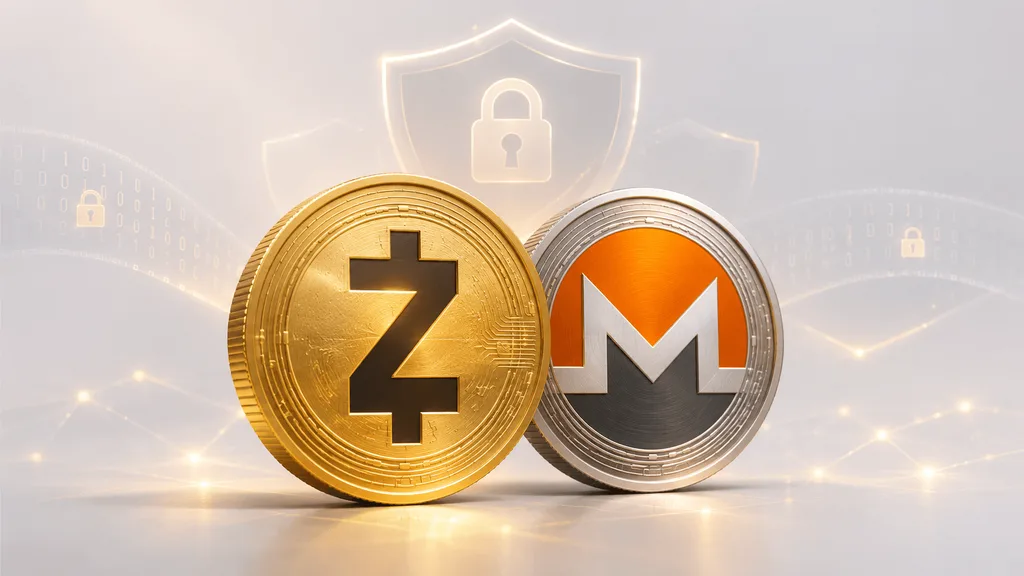
Zcash (ZEC) and Monero (XMR) are two leading examples, although they approach privacy differently. Zcash allows users to make shielded transactions, while Monero makes privacy protections a standard feature of its network.
What Is a Privacy Coin?
Most cryptocurrencies record transactions on public ledgers. Anyone can inspect Bitcoin transfers using a blockchain explorer, even if the addresses do not directly display their owners' names.
However, public transaction histories can reveal wallet balances, spending patterns and connections between accounts. Once an address becomes associated with an individual or business, its financial activity may be easier to investigate.
Privacy coins attempt to limit this exposure through cryptographic techniques that verify transactions without publicly revealing all their details.
This makes them relevant to individuals protecting personal financial information, businesses handling confidential payments and users concerned about blockchain surveillance. However, private transactions do not automatically make someone anonymous.
How Does Zcash Protect Transactions?
Zcash launched in 2016 and uses zero-knowledge proofs to enable private blockchain payments.
Its primary technology, zk-SNARKs, allows the network to verify that a transaction follows protocol rules without exposing the information being protected.
Zcash supports transparent addresses, whose activity resembles Bitcoin transactions, alongside shielded addresses that protect payment details.
When funds move between shielded addresses, the sender, recipient and amount can remain hidden from public observers. However, transfers involving transparent addresses may reveal information about the public side of a transaction.
The network's shielded transaction technology continues to evolve through protocol upgrades and security improvements.
According to the official Zcash documentation, shielded transactions remain verifiable even though their protected details are encrypted.
How Does Monero Keep Transactions Private?
Monero takes a different approach by enabling transaction privacy by default rather than requiring users to select a shielded payment option.
Its system combines three important technologies: ring signatures, stealth addresses and Ring Confidential Transactions.
Ring signatures make it difficult for outside observers to determine which participant authorized a particular transaction. Stealth addresses generate unique destination addresses, preventing straightforward connections between payments to the same recipient.
RingCT conceals transaction amounts while allowing the network to verify that transfers follow its accounting rules.
Together, these mechanisms provide privacy protections for senders, recipients and transferred amounts.
Monero's official technical documentation explains how these features work together to protect financial information.
Zcash vs. Monero: What's the Difference?
| Feature | Zcash (ZEC) | Monero (XMR) |
|---|---|---|
| Privacy model | Transparent or shielded | Private by default |
| Main technology | zk-SNARKs | Ring signatures, stealth addresses, RingCT |
| Transaction amounts | Hidden in shielded transfers | Hidden by default |
| Public transaction option | Yes | No equivalent transparent transfer mode |
| Selective disclosure | Supported through viewing capabilities | Supported through viewing and payment proofs |
The distinction matters because Zcash offers flexibility between publicly visible and shielded activity, while Monero prioritizes privacy across ordinary transactions.
Both projects have also attracted attention during periods of increased demand for privacy-focused cryptocurrencies.
Are Privacy Coins Completely Anonymous?
No cryptocurrency can guarantee complete anonymity under every circumstance.
Even when blockchain transaction details are concealed, cryptocurrency exchanges may collect identity information through know-your-customer procedures. Network connections, wallet security, transaction timing and information voluntarily shared with others can also create privacy risks.
These limitations are particularly important when attempting to protect cryptocurrency transactions.
Privacy coins also face regulatory scrutiny because their protections can make conventional financial monitoring more difficult. Exchanges may restrict support depending on applicable anti-money-laundering requirements and local regulations.
Nevertheless, the sector continues attracting development interest, including Grayscale's Zcash initiative focused on education and ecosystem support.