
Key takeaways
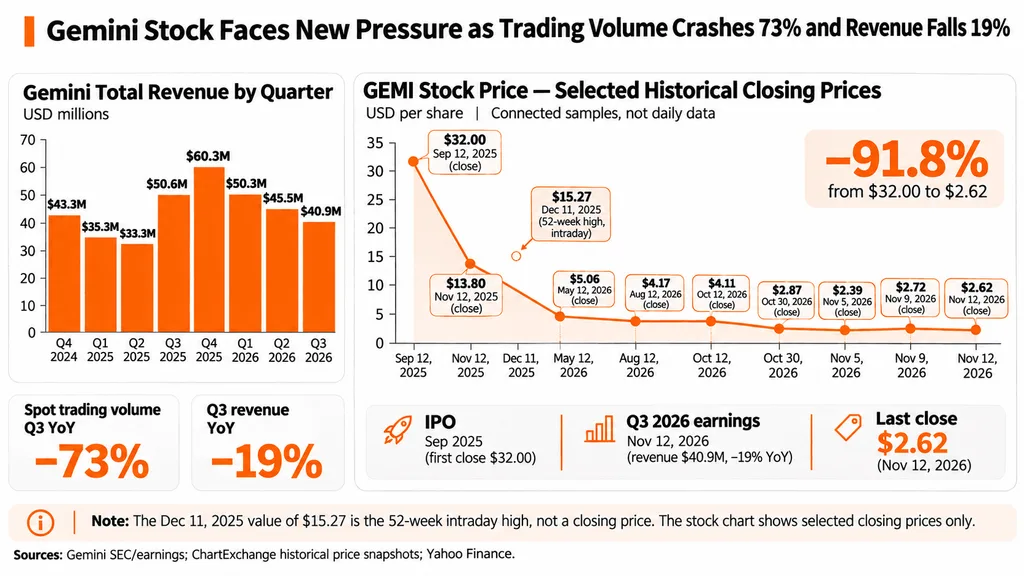
- Gemini trading volume plunges 73% year over year
- Quarterly revenue falls 19% despite expanding card business
- Net losses narrow 63% as operating costs decline
Gemini Space Station (NASDAQ: GEMI), the cryptocurrency exchange founded by Tyler and Cameron Winklevoss, reported a 73% collapse in quarterly spot trading volume and a 19% revenue decline, exposing continued weakness in its core exchange business.
According to the company's November 12 earnings release, third-quarter revenue fell to $40.9 million from $50.6 million a year earlier, while trading volume dropped from $16.4 billion to $4.5 billion.
Gemini Trading Volume Plunges 73% as Exchange Revenue Nearly Halves
Gemini's exchange revenue declined 47% year over year to $13.4 million, primarily reflecting weaker retail cryptocurrency trading activity.
Total transaction revenue fell 40% to $15.9 million, although trading volume increased 18% from the second quarter's $3.8 billion.
The sequential improvement was supported by institutional Zcash activity and expanded affiliated market-making. Approximately $1.2 billion, representing 26% of quarterly spot volume, involved transactions between external customers and Gemini's market maker.
These figures highlight the challenge facing Gemini as publicly traded crypto exchanges struggle with weaker investor participation and falling cryptocurrency valuations.
The latest results also contrast with Gemini's first-quarter revenue growth, when expanding services helped offset declining exchange activity.
Gemini Cuts Losses 63% as Credit Card Business Expands
Gemini's net loss narrowed to $58.6 million from $159.5 million a year earlier, while operating expenses declined 30% to $119.9 million.
Management attributed the reduction primarily to lower compensation and marketing costs, continuing a restructuring effort that previously contributed to Gemini layoffs and executive departures.
The company's credit card business provided a brighter spot, with revenue climbing 82% year over year to $15.5 million.
However, credit card charge-offs reached $11.5 million, compared with $3.4 million in the previous quarter, reflecting losses connected to an earlier fraud incident.
Services revenue and interest income totaled $23.3 million, representing 59% of net revenue.
The results illustrate how Gemini is becoming less dependent on exchange fees, even as its broader business remains unprofitable.
What Comes Next for GEMI Stock?
Gemini is increasingly positioning itself as a regulated financial infrastructure provider rather than solely a cryptocurrency exchange.
Prediction markets generated $800,000 in quarterly revenue, up 52% sequentially, although the business remains relatively small.
The company previously secured a CFTC clearinghouse license, allowing it to expand its derivatives and event-contract infrastructure.
Gemini is also pursuing distribution partnerships, including a preliminary agreement with Apex Fintech Solutions that has not yet been finalized.
Nevertheless, regulatory disputes involving prediction markets remain a potential obstacle to expansion.
The company ended September with $194.1 million in cash and cash equivalents, while assets on its platform stood at $13.4 billion, down from $21.3 billion a year earlier.
Investors will now assess whether improving cost controls and newer businesses can compensate for shrinking trading revenue.