
Key takeaways
- AMD and Broadcom rally as Nvidia faces leadership uncertainty
- AMD's data center revenue nearly doubles amid AI expansion
- Nvidia's CUDA ecosystem remains a major competitive barrier
AMD and Broadcom stocks surged on November 12 as investors reassessed the artificial intelligence chip market following Nvidia CEO Jensen Huang's unexpected resignation, raising questions about whether competitors could capture market share from the industry's dominant supplier.
AMD gained approximately 5.4%, while Broadcom climbed 5.5%. Nvidia fell 4.34% to $166.19, recovering from a much steeper intraday decline after its board confirmed that longtime CFO Colette Kress would become interim CEO.
The divergence follows an earlier AMD stock rally, but the question is whether investors are anticipating actual customer defections or simply reacting to uncertainty surrounding Nvidia's leadership.
AMD's AI Business Nearly Doubles as Nvidia Faces Leadership Crisis
AMD enters the leadership shakeup with stronger financial momentum than it had during previous attempts to challenge Nvidia.
According to its November 3 earnings release, third-quarter revenue increased 45% to $13.38 billion, while data center revenue surged 97% to $8.55 billion.
The growth came from EPYC server processors and Instinct MI450 GPUs, strengthening AMD's position in both conventional server computing and AI acceleration.
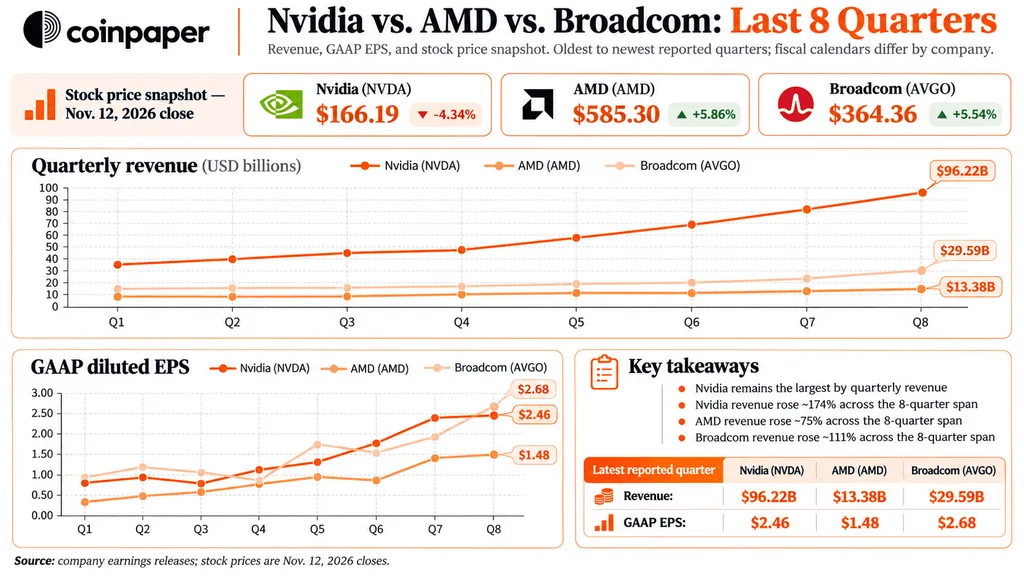
AMD also expects fourth-quarter revenue of approximately $17 billion, plus or minus 3%, suggesting that management anticipates another substantial increase.
Its recent Google Cloud partnership demonstrates another competitive advantage: AMD can supply processors supporting AI infrastructure even when customers rely on their own accelerators.
The company's Helios rack-scale systems and ROCm software platform are designed to make AMD GPUs more competitive for large AI training and inference workloads.
However, rising AMD revenue does not automatically establish that Nvidia is losing market share. Both companies can grow rapidly when overall AI computing demand expands.
Broadcom Challenges Nvidia Through Custom AI Chips
Broadcom represents a different competitive threat because it specializes in custom accelerators, networking hardware and infrastructure designed for major cloud customers.
The company reported $29.6 billion in fiscal third-quarter revenue, up 86%, with semiconductor solutions contributing approximately $20.8 billion.
Its expansion reflects growing demand for specialized silicon rather than direct competition with every Nvidia GPU.
Unlike Nvidia's general-purpose AI accelerators, custom AI chips can be optimized for specific workloads, potentially improving efficiency and reducing costs at enormous computing scale.
That strategy is especially relevant for large AI developers, where OpenAI's Broadcom relationship illustrates the growing distinction between hardware used to train frontier models and specialized processors used for inference.
Can AMD and Broadcom Actually Challenge Nvidia?
Nvidia's competitive advantage extends beyond chips.
Its CUDA ecosystem, networking products, software tools and longstanding hyperscaler relationships create switching costs that competitors cannot eliminate simply by offering alternative processors.
Huang's departure creates uncertainty around those relationships, particularly after the company's leadership transition ended more than three decades under its founder.
Yet there is no confirmed evidence that major Nvidia customers have canceled orders because of the resignation.
Investors must also consider whether expensive AI infrastructure financing could eventually constrain demand across all three chipmakers.