BNY enables institutional XRP custody without confirming new purchases
XRP ETFs hold substantial assets despite renewed investor withdrawals
Ripple's expanding financial partnerships do not guarantee XRP accumulation
BNY's decision to offer institutional custody for XRP represents another step toward integrating the cryptocurrency into traditional financial markets. But one important question remains unanswered: how much additional XRP will institutions actually purchase?
The bank, which oversees approximately $63.4 trillion in assets under custody or administration, expanded its partnership with Ripple on October 27, adding XRP and RLUSD to its Digital Asset Custody platform.
BNY's $63.4 Trillion Custody Business Is Not XRP Demand
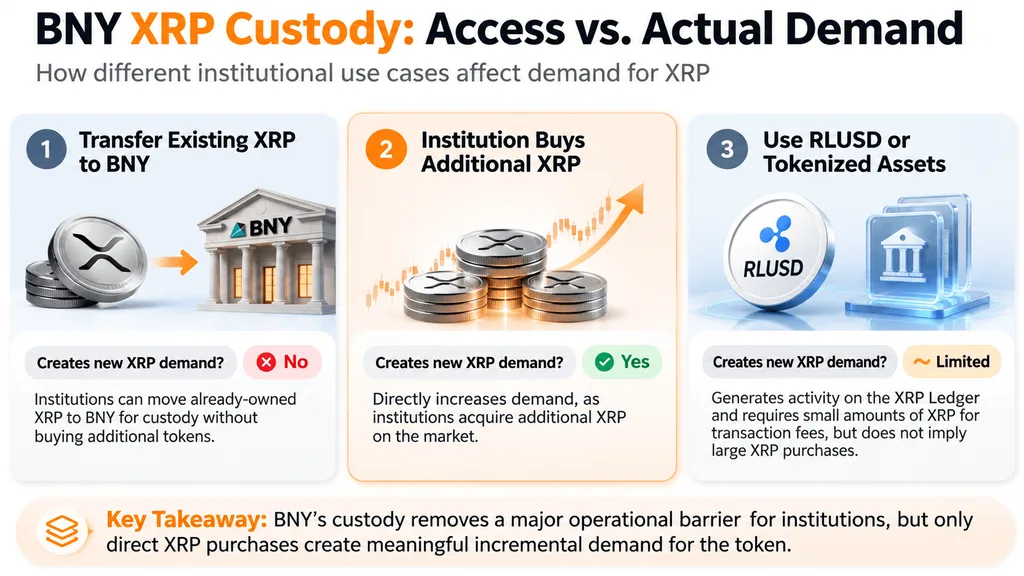
The distinction between offering custody and purchasing cryptocurrency is critical.
BNY's existing digital asset infrastructure allows institutions to safeguard XRP within an established financial servicing framework.
But transferring previously purchased tokens from another custodian to BNY does not create additional market demand. New demand would require institutions to increase their XRP holdings rather than simply change where those assets are stored.
BNY's $63.4 trillion figure also represents assets held or administered across its broader financial business, not money available for XRP investment.
The bank already has an established role in cryptocurrency investment products. For example, BNY provides administrative and shareholder services for the Bitwise XRP ETF, while Coinbase Custody safeguards the fund's underlying XRP.
XRP ETF Flows Reveal a More Measurable Market
Exchange-traded funds provide a clearer, although imperfect, indication of investor appetite.
US spot XRP ETFs held approximately $1.24 billion in combined net assets as of November 9, according to SoSoValue-based data. Cumulative net inflows approached $1.8 billion.
Yet the funds recorded approximately $10.42 million in withdrawals on November 9, with Bitwise responsible for roughly $9.4 million.
The reversal follows earlier ETF inflow weakness, showing that improved institutional infrastructure has not consistently translated into fresh investment.
ETF flows also measure only one channel of demand. Institutions can hold XRP directly, through private arrangements or with specialized custodians without appearing in exchange-traded fund statistics.
Will RLUSD and Tokenized Finance Increase XRP Buying?
Ripple and BNY are also exploring direct RLUSD minting and redemption, broader tokenized asset custody, and supply-chain financing through C2FO.
These planned services could increase activity on the XRP Ledger, but they do not necessarily require equivalent XRP purchases.
Ripple's expanding RLUSD ecosystem supports dollar-denominated settlement, while XRP remains the network's native asset for transaction fees, reserves and certain liquidity functions.
Similarly, institutional tokenized fund activity can expand without institutions purchasing XRP equal to the value of the assets represented onchain.
The distinction helps explain why XRP previously declined despite Ripple's banking expansion.