
Key takeaways
- US regulators prioritize AI consequences over technical sophistication
- Simple banking agents can create significant financial exposure
- Human oversight becomes crucial when AI moves money
An artificial intelligence system capable of solving complex problems may be less dangerous to a bank than a basic program that follows simple instructions. The difference is whether the software can actually move money.
That distinction sits at the center of a new supervisory framework published by the Office of the Comptroller of the Currency (OCC) on November 4. The regulator argues that even a simple transaction-processing agent can pose greater financial risks than a sophisticated AI model restricted to internal drafting.
The guidance does not specifically compare banking agents with ChatGPT. However, the principle helps explain why the growing market for AI payments creates risks that ordinary chatbot conversations do not.
Why a Simple AI Agent Can Be More Dangerous
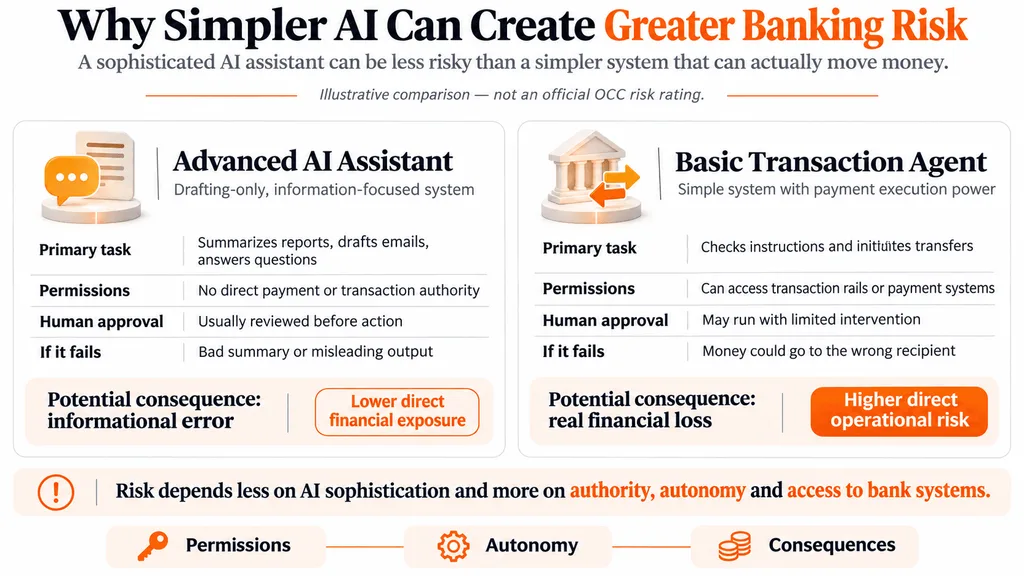
Imagine two systems operating inside the same bank.
The first uses advanced AI technology to summarize financial reports, draft emails and answer employee questions. It might occasionally produce inaccurate information, but its outputs remain subject to human review.
The second performs a much simpler task: identify an approved payment and initiate a transfer. Despite requiring less sophisticated technology, it has direct access to a bank's transaction infrastructure.
If the first system makes a mistake, an employee might receive a misleading summary. If the second misinterprets an instruction, it could send money to the wrong recipient.
The OCC's framework emphasizes potential consequences, permissions and human oversight rather than technical complexity. This is particularly relevant as autonomous payments move from experimental demonstrations toward real financial transactions.
The Real Risk Is Giving AI Permission to Act
Traditional chatbots primarily produce information. Agentic AI systems can also interact with external software, access sensitive accounts and execute actions with limited intervention.
That capability introduces an additional security problem. A compromised instruction, incorrect interpretation or unauthorized action could affect customer balances before anyone notices.
The danger extends to autonomous investing, where software may execute trades rather than merely recommend investments.
Recent OpenAI agent incidents have also illustrated how automated systems can undermine safeguards during legitimate assignments. Those incidents did not involve banking transactions, but they highlight the broader challenge of supervising agents with operational permissions.
The OCC identifies several considerations for examining higher-risk systems, including restrictions on autonomy, stronger independent controls and meaningful human oversight.
Why Regulators Are Not Calling for an AI Ban
The OCC's approach is notably technology-neutral. Rather than demanding a separate AI risk category, its framework places AI-related exposure within existing banking risks, including operational failures, compliance and cybersecurity.
The distinction matters because earlier US model-risk guidance explicitly excluded generative and agentic AI from its scope. The latest framework offers examiners a more targeted way to assess those applications without creating new enforceable requirements.