Key takeaways
- Moody's assigns RLUSD A2 and top-tier P-1 ratings
- Ripple targets 103% reserve coverage with BNY custody
- Bankruptcy protections remain a weakness despite banking approval
Ripple's RLUSD stablecoin has received investment-grade ratings from Moody's just one day after the company secured final approval for its US national trust bank, strengthening its institutional credentials as the token's market capitalization exceeds $2.5 billion.
Moody's assigned RLUSD an A2 long-term deposit rating and a P-1 short-term rating on October 27. A2 represents upper-medium-grade credit quality, while P-1 is Moody's highest short-term rating.
Moody's Gives RLUSD A2 Rating as Reserves Target 103% Coverage
Moody's evaluated RLUSD's reserve quality, liquidity, redemption arrangements, custody structure and operational safeguards.
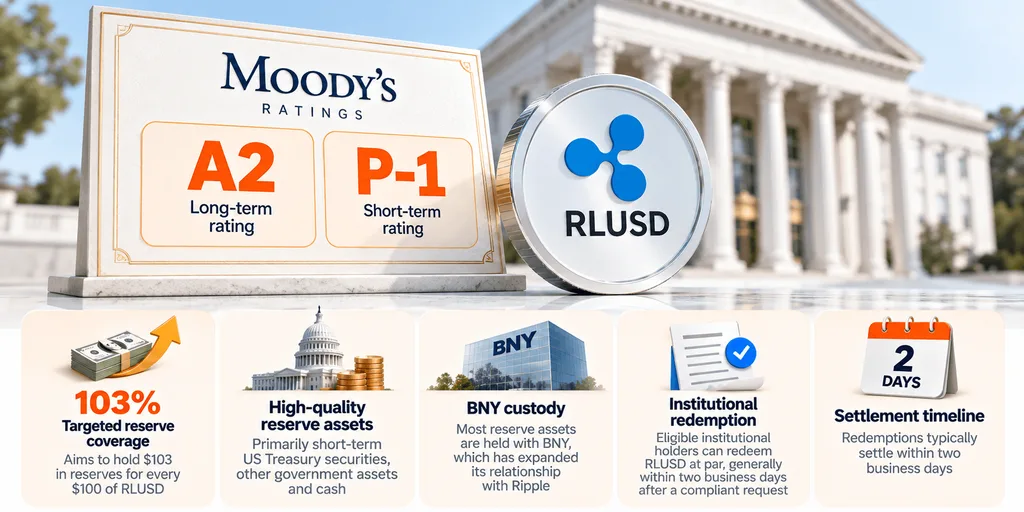
The stablecoin is issued by Ripple subsidiary Standard Custody & Trust Company on the XRP Ledger and Ethereum. Its backing consists primarily of short-term US Treasury securities, other highly liquid government assets and cash.
Standard Custody targets reserve coverage of 103%, meaning it aims to maintain $103 in backing for every $100 of RLUSD outstanding.
That is a target rather than a guarantee that reserves always remain at precisely that level.
Most reserve assets are held with BNY, which has expanded its relationship with Ripple through additional XRP and RLUSD custody services.
Moody's also examined redemption arrangements. Eligible institutional holders can redeem RLUSD directly at par, with settlement generally available within two business days after a compliant request.
However, those direct redemption arrangements are not automatically available to every retail holder.
Ripple Bank Approval Strengthens RLUSD's Institutional Structure
The rating follows Ripple's October 26 final OCC approval to establish Ripple National Trust Bank.
Under the approved structure, Standard Custody remains the RLUSD issuer, while the federally supervised trust bank will manage segregated reserves and serve as collateral trustee for token holders.
The development adds federal oversight to Ripple's stablecoin infrastructure without turning RLUSD into an FDIC-insured bank deposit.
Institutional adoption has also expanded through Standard Chartered, which introduced RLUSD custody services connected to proposed trading-collateral arrangements.
Meanwhile, Coinbase recently added RLUSD across its exchange, institutional and retail platforms, expanding distribution beyond Ripple's existing banking partnerships.
Why Moody's Still Sees Bankruptcy Risk
Despite the investment-grade ratings, Moody's identified legal protections as an area requiring improvement.
Standard Custody is not structured as a bankruptcy-remote entity, and RLUSD holders currently lack direct ownership interests in reserve assets.
This creates potential complications if the issuer enters insolvency proceedings, including delays in accessing funds.
Moody's indicated that stronger legal protections, including provisions of the GENIUS Act expected to take effect in 2027, could support an improved rating.
Conversely, deteriorating reserve quality, weaker liquidity or operational failures could trigger a downgrade.
The rating also does not guarantee that RLUSD will always trade at exactly $1 or that every holder can redeem immediately.
For XRP investors, the distinction remains important. RLUSD's expansion strengthens Ripple's financial infrastructure, but stablecoin growth does not automatically create proportional XRP demand.
Earlier analysis of RLUSD payment activity also demonstrated why token circulation, transaction counts and actual economic usage must be evaluated separately.