Key takeaways
- XRPL developers propose four fixes for token authorization gaps
- New rules target unauthorized holdings across payments and trading
- Changes remain unapproved with no known external exploitation
XRP Ledger developers are working on four security-related fixes designed to prevent restricted digital assets from reaching accounts without authorization, addressing potential weaknesses in infrastructure increasingly used for institutional tokenization.
The changes are grouped under a proposed amendment called fixCleanup3_5_0, with the underlying GitHub code proposal updated on October 27. The fixes would strengthen issuer-controlled token permissions across payments, automated market makers and other transactions.
XRP Ledger Developers Target Four Authorization Weaknesses
The proposal focuses on tokens requiring explicit issuer authorization before an account can hold them.
These restrictions are particularly relevant for regulated stablecoins and tokenized securities, where issuers may need to verify investors' identities or enforce eligibility requirements.
Under the existing architecture, approval is recorded through a trust line connecting an account to a token issuer. Developers identified several circumstances where transactions could bypass the intended authorization checks.
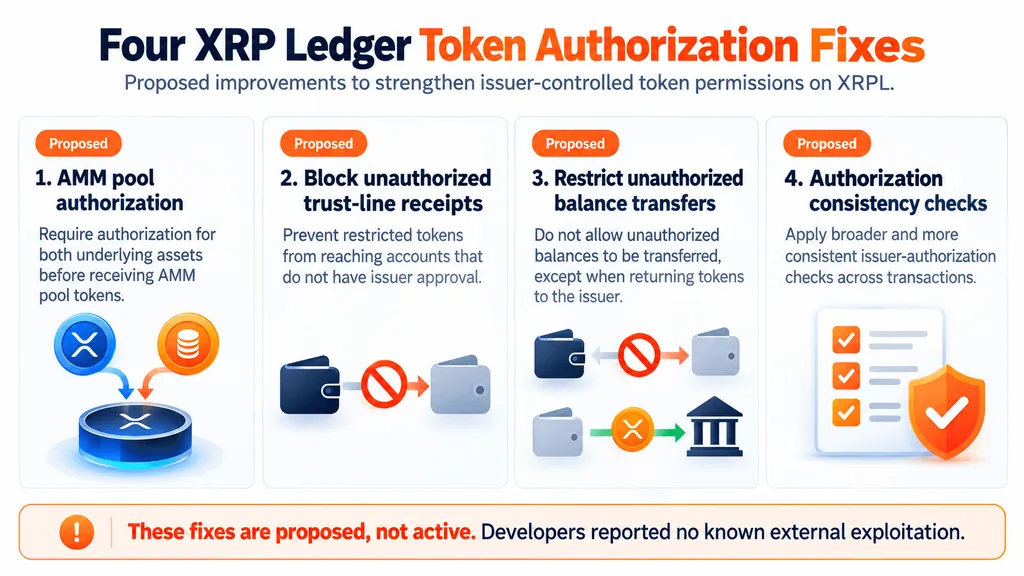
One issue involves automated market maker liquidity tokens, which represent claims on assets deposited into trading pools. The proposed correction would require recipients to have authorization for both underlying assets before acquiring a pool token.
Another addresses an exemption affecting trust lines with existing balances. Previously, certain checks applied only when a trust line held zero tokens, potentially allowing an unauthorized balance to increase through subsequent transactions.
The broader package also seeks to prevent unauthorized token balances from being used in transfers other than redemption to the issuer and introduce additional consistency checks.
These changes follow earlier work on permissioned liquidity pools, where developers explored restricting participation to verified institutional counterparties.
Why the Fixes Matter for Institutional Tokenization
The proposed changes arrive as traditional financial institutions expand their use of the XRP Ledger for digital assets.
BNY recently expanded its XRP and RLUSD custody capabilities, while Ripple has pursued relationships involving stablecoin settlement, tokenized securities and institutional financing.
For regulated institutions, the ability to control which accounts can legally receive or hold specific assets is essential.
An issuer distributing tokenized fund shares, for example, may need to ensure those tokens remain with eligible investors. If a secondary-market transaction or liquidity-pool mechanism bypasses authorization checks, the system's compliance controls become less reliable.
The proposed fixes would strengthen those protections without changing XRP's native ownership model or requiring ordinary XRP holders to obtain issuer permission.
The work also follows an earlier XRPL security release, which introduced separate protections for the network's Batch transaction functionality.
When Could the XRP Ledger Security Upgrade Activate?
The four changes have not been merged into the XRP Ledger's main software or activated on mainnet.
Once implementation and review are complete, the amendment would still need support from more than 80% of trusted validators for two consecutive weeks before activation.
The process is separate from the earlier November 4 upgrade window, which concerns fixCleanup3_4_0 rather than the newly proposed fixCleanup3_5_0.