
Key takeaways
- Alphabet spent more cash building infrastructure than operations generated
- Google Cloud doubled revenue despite growing investor concerns
- Negative free cash flow exposed AI investment risks
Google made more than $40 billion in operating profit during the third quarter of 2026, generated record cloud revenue, and reported its thirteenth consecutive quarter of double-digit revenue growth. Yet its shares plunged roughly 12% on October 29, raising an uncomfortable question: how can one of the world's most profitable companies suddenly look so expensive to investors?
The answer lies in Alphabet's third-quarter financial results. Google spent $51.36 billion on property and equipment during the quarter, more than double the $23.95 billion invested a year earlier, as its artificial intelligence expansion increasingly resembles an industrial infrastructure project.
How Google Turned $42 Billion in Cash Into a $9 Billion Shortfall
Alphabet generated $42.29 billion in operating cash flow between July and September. However, its $51.36 billion in capital expenditure exceeded that amount, producing negative free cash flow of $9.07 billion.
That distinction matters. Capital expenditure is money invested in long-term assets, including servers, networking equipment and data centers. Unlike ordinary operating expenses, these investments generally appear on the balance sheet and are expensed gradually through depreciation.
Google therefore remained profitable despite spending more cash on infrastructure than its operations generated. Its consolidated operating income actually increased 30% to $40.58 billion.
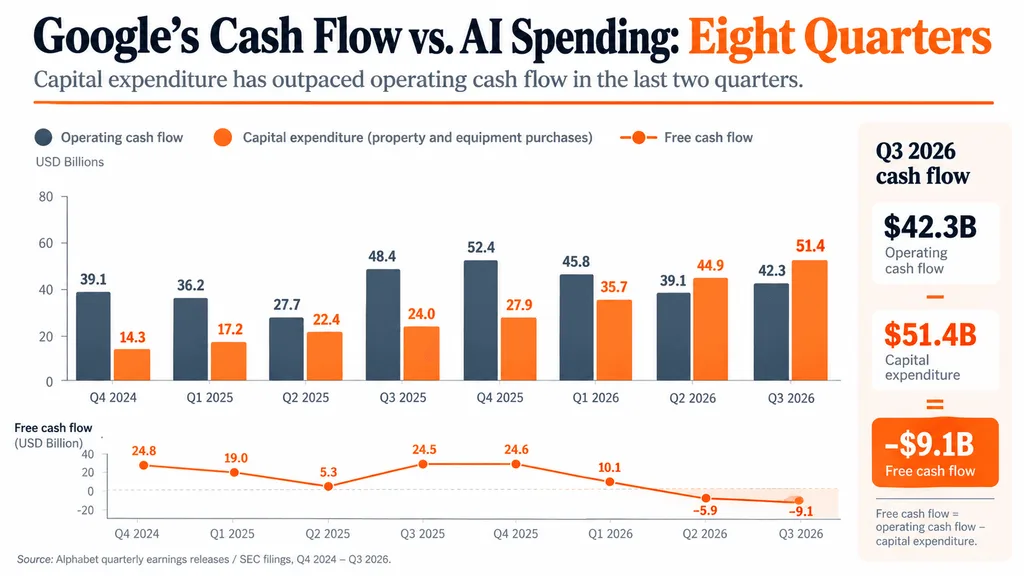
The deterioration was not entirely caused by AI. Alphabet also faced an inventory buildup for its custom TPU chips and a $5.2 billion payment related to an earlier European Commission fine, adding pressure to operating cash flow.
Nevertheless, the result marked Alphabet's second consecutive quarter of negative free cash flow. Similar concerns about AI financing have spread across the technology sector as infrastructure investments grow faster than near-term cash generation.
Why Did Google Stock Fall Despite 103% Cloud Growth?
Google Cloud revenue more than doubled to $30.71 billion, while its operating income reached $11.12 billion. Those numbers demonstrated substantial demand for AI infrastructure, enterprise applications and Google's custom computing systems.
However, Google Search revenue grew only 12%, compared with 17% in the preceding quarter. Investors were increasingly questioning whether AI-powered search would generate advertising revenue as efficiently as traditional search results.
The selloff also followed an earnings disappointment. Revenue of $127.58 billion fell below analysts' expectations, while diluted earnings per share declined from $2.87 to $2.12, partly reflecting losses on equity investments.
A similar tension appeared in ServiceNow's earnings, where strong AI demand failed to prevent a sharp stock selloff. Investors were looking beyond current revenue toward the profitability of future growth.
Is Google's AI Spending Becoming Too Expensive?
Alphabet expects capital expenditure of $195 billion to $205 billion in 2026, with spending projected to increase significantly in 2027. The scale raises questions about how quickly its investments will produce sufficient cash returns.
Investors had already questioned rising infrastructure costs during Alphabet's earlier stock selloff. The latest results suggest those concerns have become more immediate.