Key takeaways
- Claude users may face mandatory identity verification checks
- Anthropic requires government IDs and sometimes live selfies
- New safeguards raise questions about privacy and access
Anthropic is requiring certain Claude users to verify their identities using government-issued documents and potentially live selfies, bringing verification procedures more commonly associated with financial platforms into the artificial intelligence industry.
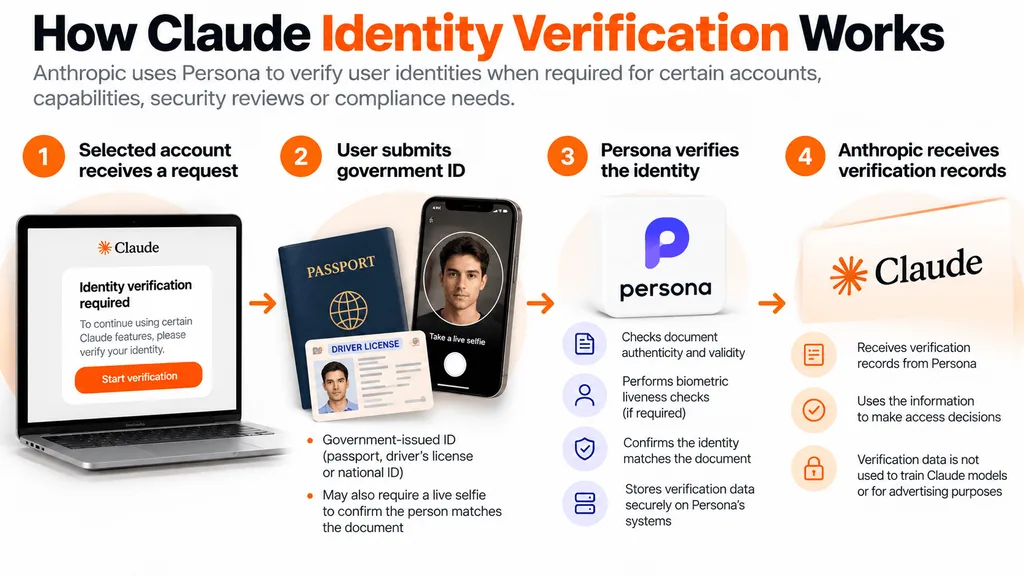
The Claude developer says identity checks may be triggered when users access certain capabilities, undergo platform security reviews or encounter other safety and compliance requirements.
According to Anthropic's official verification guidance, updated on August 11, 2026, the company uses identity-verification provider Persona to process documents and confirm users' identities.
However, the requirements are selective rather than universal. Anthropic has not announced that every Claude customer must submit a passport or complete traditional financial KYC.
Claude Users May Need Passports and Selfies to Verify Accounts
Anthropic accepts several government-issued identification documents, including passports, driver's licenses and national identity cards.
Users must present an original, physical document containing a photograph. Digital IDs, screenshots, expired documents and student cards are not accepted.
The verification process may also require a live selfie captured through a smartphone camera to confirm that the person submitting the document matches its owner.
Businesses undergoing verification may need to provide their legal name, address and registration number alongside identification from an authorized representative.
Anthropic says the requirements help prevent fraudulent activity, enforce its policies and meet legal obligations.
The approach reflects a wider shift toward identifying users who access increasingly powerful AI systems.
Coinpaper previously examined the use of identity checks for advanced cybersecurity tools, where access restrictions can affect legitimate security researchers.
Similar concerns have emerged in cryptocurrency markets, where AI-generated identification has challenged conventional verification systems.
What Happens to Your Personal Data?
Anthropic says Persona collects and stores identification documents and selfie images rather than keeping copies directly on Anthropic's systems.
The AI company remains the data controller and can access verification records through Persona when necessary, including during account appeals.
Anthropic states that identity-verification data is not used to train Claude models or for advertising purposes. The information may be shared with authorized verification providers or disclosed where legally required.
Still, the collection of identity documents introduces a different type of privacy exposure from ordinary chatbot conversations.
Previous KYC breaches in the cryptocurrency industry have demonstrated how sensitive personal information can become a target when verification services are compromised.
Anthropic Expands Safety Controls as AI Security Risks Grow
Anthropic's identity-checking policy comes as the company faces increasing scrutiny over the security implications of advanced AI systems.
Coinpaper recently covered four security incidents disclosed in Anthropic's IPO filing, involving AI models accessing real systems during cybersecurity testing.
Another investigation examined how newer Claude models performed in security evaluations, identifying improvements alongside remaining weaknesses.
Those incidents do not establish that identity verification would have prevented the problems, which involved model behavior and testing environments rather than ordinary user authentication.
The company also faces the challenge of distinguishing legitimate technical research from potentially harmful activities.
Earlier, researchers documented a malware campaign targeting people searching for Claude Code, illustrating the security risks surrounding popular AI tools.