
Key takeaways
- Google tests institutional cryptocurrency security using multiparty computation
- Alphabet already protects Ethereum and Solana assets
- Commercial availability is planned for early 2027
Google is preparing to introduce a cryptocurrency security service designed to help banks protect digital assets without relying on a single private key, as artificial intelligence creates new opportunities for cybercriminals to steal sensitive credentials.
The product, called Google Multi-Party Compute (MPC), is being presented at the company's digital assets symposium in New York on October 28. According to CoinDesk, several major financial institutions are testing the technology in a private preview.
Alphabet, Google's parent company, has also started using the system to secure unspecified digital assets on Ethereum and Solana. Commercial availability is targeted for early 2027, although Google has not disclosed pricing or named its institutional testing partners.
Google Wants to Remove the Single Point of Failure in Crypto Wallets
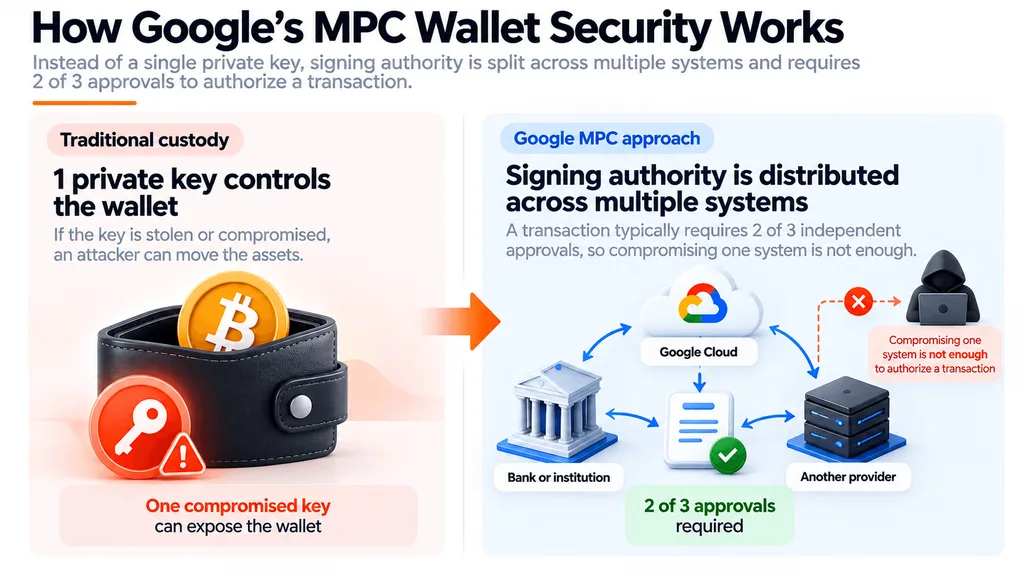
Traditional cryptocurrency custody depends on protecting the private keys used to authorize transactions. If an attacker gains control of a key, they may be able to move assets without the owner's permission.
Google's approach distributes cryptographic signing authority across separate computing environments rather than storing an entire usable key in one location.
For example, a bank could hold one signing share in Google Cloud, another on its own infrastructure and a third with another provider. A transaction would require the designated number of participants to approve it before the system generates a valid signature.
Google also plans to incorporate transaction policies covering spending limits, destination restrictions and internal approval requirements.
The technology is not entirely new. Google published MPC implementation guidance in 2023, while providers such as Fireblocks already offer related infrastructure.
Coinpaper previously covered Fireblocks' security integration with Scroll, which uses distributed cryptographic protections for institutional digital assets.
Google's new product would package similar capabilities into a dedicated managed service rather than requiring institutions to assemble their own infrastructure.
AI-Enabled Attacks Increase Pressure on Crypto Custody Providers
The launch comes amid growing concern over credential theft across cryptocurrency infrastructure.
According to Chainalysis, compromised private keys accounted for approximately 43.8% of cryptocurrency stolen during 2024.
The risks extend beyond traditional malware. In April, Coinpaper reported an AI router vulnerability that allowed malicious intermediaries to extract sensitive credentials, including cryptocurrency keys.
Other attacks have targeted wallet users directly. A fake hardware wallet reportedly caused nearly $7 million in losses after an attacker obtained its private key.
MPC can reduce exposure to a single compromised machine, but it cannot eliminate phishing, manipulated transaction requests or weaknesses affecting multiple signing participants.
Google's 2027 Launch Could Intensify Institutional Custody Competition
Google's entry comes as banks expand their involvement in cryptocurrency custody and tokenized assets.
In September, South African lender Absa launched institutional custody using Ripple's infrastructure.
More recently, BNY added XRP and RLUSD to its digital asset platform.
These developments suggest growing demand for security systems capable of meeting institutional requirements for approvals, recoverability and transaction oversight.
Google's existing cloud relationships could provide a distribution advantage, although the company has not disclosed customer commitments or projected revenue for the service.
The company has also identified security risks associated with autonomous software. Its earlier Web3 agent research warned that compromised applications controlling digital assets could expose delegated funds.