Key takeaways
- US gas production forecast reaches record 112.2 Bcf/d
- American LNG exports expected to surge 17% in 2026
- European prices approach €100 as winter storage weakens
US natural gas production is heading toward another annual record, reaching a projected 112.2 billion cubic feet per day in 2026, even as European gas prices approach €100 per megawatt-hour amid renewed fears of an energy crisis.
The contrast highlights a widening divide between the world's largest gas producer and European buyers struggling with disrupted imports and unusually low winter inventories.
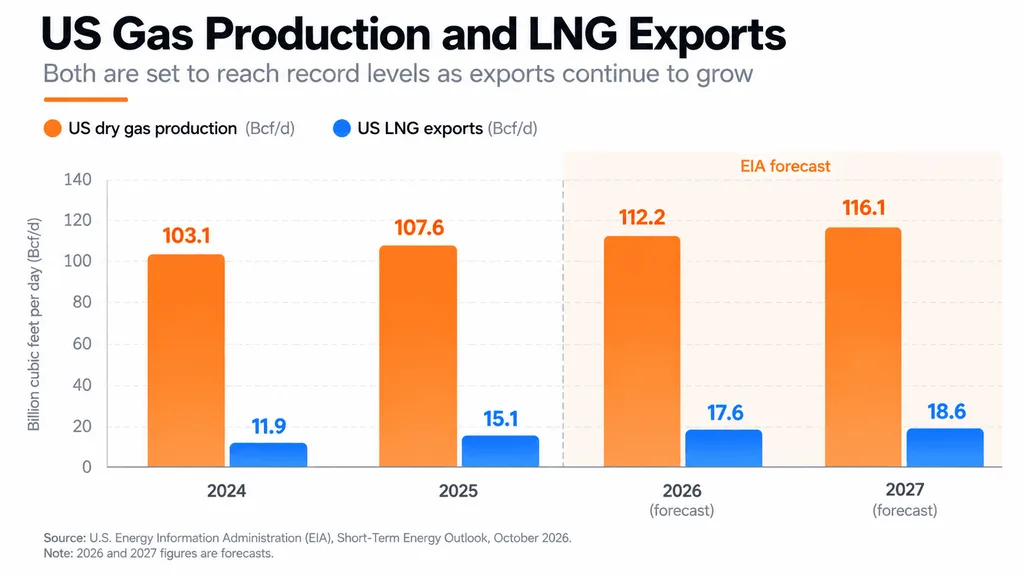
According to the US Energy Information Administration, American production is expected to rise from 107.6 billion cubic feet per day in 2025 to 112.2 billion in 2026, before reaching 116.1 billion in 2027.
Meanwhile, European benchmark gas prices reached approximately €98.99/MWh on October 28, up 42.5% over the past month and more than 200% year over year, according to Trading Economics.
US Natural Gas Output Heads for Record as LNG Exports Surge 17%
The EIA expects US liquefied natural gas exports to average 17.6 billion cubic feet per day this year, compared with 15.1 billion in 2025.
That represents growth of approximately 16.6%, driven by expanding export facilities and stronger demand from international customers.
The agency forecasts another increase to 18.6 billion cubic feet per day in 2027.
Production growth is concentrated in the Permian Basin and Haynesville shale, where companies are expanding output while controlling spending.
Expand Energy expects to produce 7.4–7.6 billion cubic feet equivalent per day in 2026, with capital expenditure of approximately $2.75 billion–$2.95 billion.
EQT has also agreed to acquire Range Resources in a $13 billion all-stock transaction, potentially creating America's largest natural gas producer with combined output exceeding 9 Bcf equivalent per day.
The expansion builds on an earlier US gas record, when output reached approximately 111.5 Bcf/d in August while European prices were already climbing.
European Gas Nears €100 as Winter Storage Falls Behind
Europe's supply picture looks substantially weaker.
The European Union's energy regulator, ACER, reported that storage facilities were approximately 75% full on October 21, below historical seasonal averages.
More recent storage data for October 26 showed inventories at 74.9%, compared with 82.9% a year earlier and a five-year average of approximately 89.6%.
Germany's reserves were particularly low at around 61.6%, leaving Europe's largest economy exposed to stronger winter demand.
The latest increase reverses the February gas decline, when prices fell despite weak inventories because traders expected LNG imports to ease supply concerns.
Disruptions to Middle Eastern LNG shipments have further tightened international supply.
ACER estimates that the regional conflict has added €18 billion-€33 billion to Europe's gas-import costs, while US LNG now represents around 30% of total EU gas supply.
Why Record US Production Cannot Immediately Fix Europe's Crisis
Despite Europe's price surge, US Henry Hub gas remains near $3/MMBtu, substantially below European LNG-equivalent prices.
The discrepancy reflects transportation, liquefaction and regasification costs, limited export capacity and differences between domestic and international gas markets.
For American exporters, higher European prices can create stronger commercial opportunities, although long-term contracts determine how much of the difference becomes profit.
Domestic consumption is also increasing as AI data centers require additional electricity, potentially adding billions of cubic feet to future gas demand.
The broader electricity shortage has encouraged technology companies to secure new generation capacity, including gas-powered projects.
Higher European energy costs also threaten renewed inflation pressure, complicating central-bank decisions as winter approaches.
Meanwhile, rising US energy costs show that abundant natural gas production does not guarantee cheaper gasoline, diesel or other petroleum products.