Key takeaways
- AI financing fears push investors toward safer Treasuries
- US government debt approaches $40 trillion amid deficits
- Inflation and borrowing costs complicate the Fed outlook
Wall Street's biggest bond-market concern may no longer be the Federal Reserve. Investors are increasingly watching whether the debt-funded artificial intelligence boom can survive its own enormous financing requirements.
US Treasury bonds have recovered from their early-October selloff, even as inflation remains elevated and another interest rate increase remains possible in December.
According to Reuters, concerns about financing problems in AI infrastructure have encouraged investors to shift money from riskier technology investments into government debt.
The change is significant because the US 10-year Treasury yield has risen approximately 84 basis points during 2026 despite the recent recovery in bond prices.
AI Debt Fears Are Driving Money Into Treasury Bonds
The bond market's recovery began as investors questioned whether AI infrastructure companies could continue financing expensive data centers, chips and electricity contracts.
Corporate borrowing tied to artificial intelligence has expanded rapidly, with Goldman Sachs estimating that hyperscaler debt issuance could reach $420 billion in 2027, approximately 60% above projected 2026 levels.
But investors are becoming more selective.
CoreWeave, one of Nvidia's major cloud-computing partners, recently saw its bond yields approach 15%, reflecting concerns about its borrowing requirements and ability to finance additional capacity.
The company's credit-default swaps also exceeded 1,000 basis points, suggesting investors were demanding substantially greater compensation for potential credit losses.
Those developments help explain the contrast between weak AI credit markets and stronger demand for US government securities.
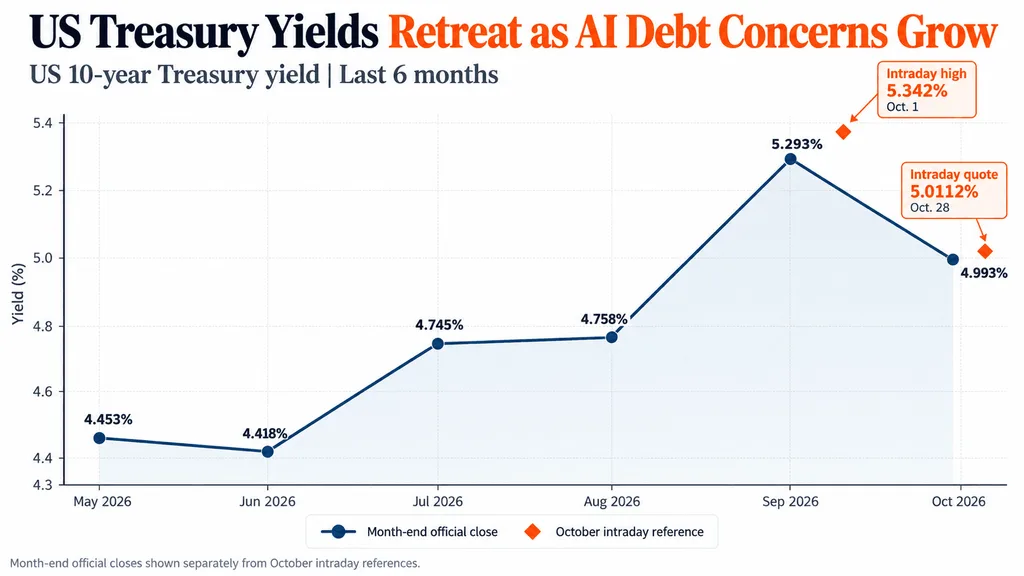
When investors purchase Treasuries, bond prices rise and yields fall. The mechanism works independently of changes to the Fed's benchmark interest rate.
The $40 Trillion US Debt Problem Has Not Disappeared
Despite the recent rally, Treasury investors face a separate challenge: Washington's growing borrowing requirements.
US federal debt stands around $40 trillion, while annual budget deficits remain near 6% of gross domestic product.
The government must regularly issue additional securities to finance spending and refinance existing obligations, increasing the supply investors must absorb.
Coinpaper previously examined how Treasury Secretary Scott Bessent's bond buybacks could improve market liquidity without eliminating underlying borrowing pressure.
That problem became visible when Treasury yields reached approximately 5.35% earlier in October, their highest levels since 2002.
Even the recent recovery has not erased those concerns.
PIMCO previously described government bonds as unusually attractive following the yield surge, highlighting how Treasury valuations could appeal to investors seeking protection from technology-market volatility.
Why the Fed May No Longer Control the Entire Bond Story
The Federal Reserve is widely expected to hold its benchmark rate steady at the October 28 meeting, although investors remain concerned about another increase in December.
Persistent inflation and elevated energy prices could encourage policymakers to maintain restrictive borrowing conditions.
Meanwhile, AI-related credit risks have created a different influence on financial markets.
As Coinpaper's examination of AI financing explained, developers increasingly borrow against future computing revenue before expensive infrastructure begins generating sufficient cash.
That creates a potential vulnerability when demand disappoints or refinancing costs rise.
The consequences were also explored in a recent analysis of $466 billion in AI debt, including risks facing bondholders, private lenders and institutional investors.