Key takeaways
- Nvidia commits $3 billion to Meta's equity offering
- Companies expand Muse development and next-generation AI infrastructure
- Investment raises questions about financing between AI partners
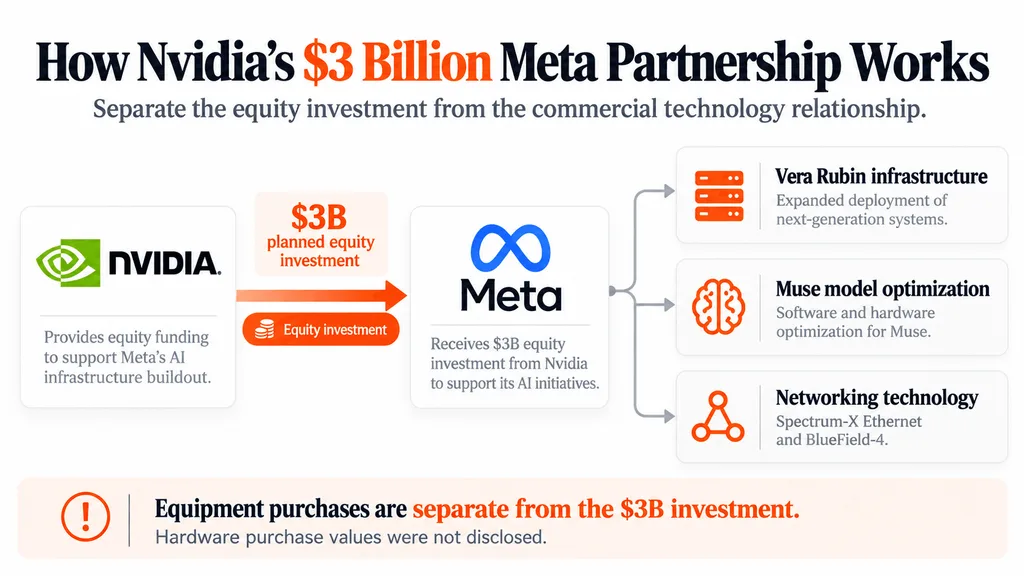
Nvidia is investing $3 billion in Meta's latest equity offering as the two technology giants deepen their partnership around Muse, Mark Zuckerberg's artificial intelligence assistant, and the infrastructure required to run increasingly powerful AI agents.
The companies announced the agreement on October 27, outlining plans to improve Muse's training and inference performance while expanding Meta's deployment of Nvidia processors and networking equipment.
The investment marks another step in Nvidia's transformation from a supplier of expensive AI chips into a financial backer of the companies purchasing them.
Nvidia and Meta Expand Partnership Around Muse AI
Muse is central to Zuckerberg's ambition to develop personal AI agents that can complete increasingly complex tasks across everyday applications.
The assistant, developed internally under the name Hatch, can connect to services involving email, calendars, shopping and payments, with users able to revoke access.
Meta says its Muse models have already demonstrated strong benchmark performance and growing consumer adoption. However, the companies have not disclosed new revenue figures or measurable cost savings resulting from their expanded partnership.
Under the agreement, Nvidia and Meta will optimize the software and hardware supporting Muse to improve performance while reducing the cost of running AI workloads.
Meta also intends to increase its deployment of Nvidia's next-generation Vera Rubin systems and Vera CPUs, alongside Spectrum-X Ethernet networking and BlueField-4 processors.
The companies are considering additional cooperation involving Nvidia's OpenShell architecture and Sentry monitoring technology.
Those tools are designed to help developers establish boundaries around autonomous AI systems, an area Nvidia has already explored through its AI security framework.
Meta's AI Fundraising Creates an Unusual Financial Relationship
The agreement arrives as Meta undertakes one of the largest corporate financing programs associated with artificial intelligence.
The company has expanded its planned equity fundraising to approximately $97.5 billion, according to Reuters, including funding intended to support infrastructure development.
Coinpaper recently examined Meta's financing strategy, highlighting why a company with substantial cash reserves is seeking additional capital.
Nvidia's participation adds another dimension because Meta is already one of its major customers.
The chipmaker supplies processors and networking equipment for Meta's data centers while now preparing to become an investor in the same business.
Such arrangements have attracted scrutiny because suppliers can help finance customers who subsequently purchase their products.
Earlier Nvidia financing deals prompted questions about how AI infrastructure investment is funded and whether equipment retains sufficient value over time.
The concern is not that Nvidia's investment automatically creates improper accounting. Rather, investors need to distinguish genuine end-customer demand from financing arrangements within the AI supply chain.
What the $3 Billion Deal Means for the AI Industry
For Meta, closer integration with Nvidia could improve computing efficiency as Muse reaches more users.
For Nvidia, the arrangement strengthens an established relationship while potentially providing an equity return if Meta's AI investments succeed.
The partnership builds on a broader trend in which chipmakers, cloud providers and AI developers increasingly finance one another.
Coinpaper previously examined where AI spending goes, showing that equipment suppliers often receive payments before AI platforms generate corresponding profits.
Recent GPU financing arrangements illustrate how expensive computing infrastructure is being funded through increasingly complex structures.
The agreement also follows earlier warnings about off-balance-sheet AI exposure, where guarantees and special-purpose financing arrangements can make infrastructure risks harder to evaluate.