Key takeaways
- Brazil's Ibovespa plunges over 17% after election shock
- Brazilian real tumbles nearly 12% against US dollar
- B3 suspends trading as government cancels bond auctions
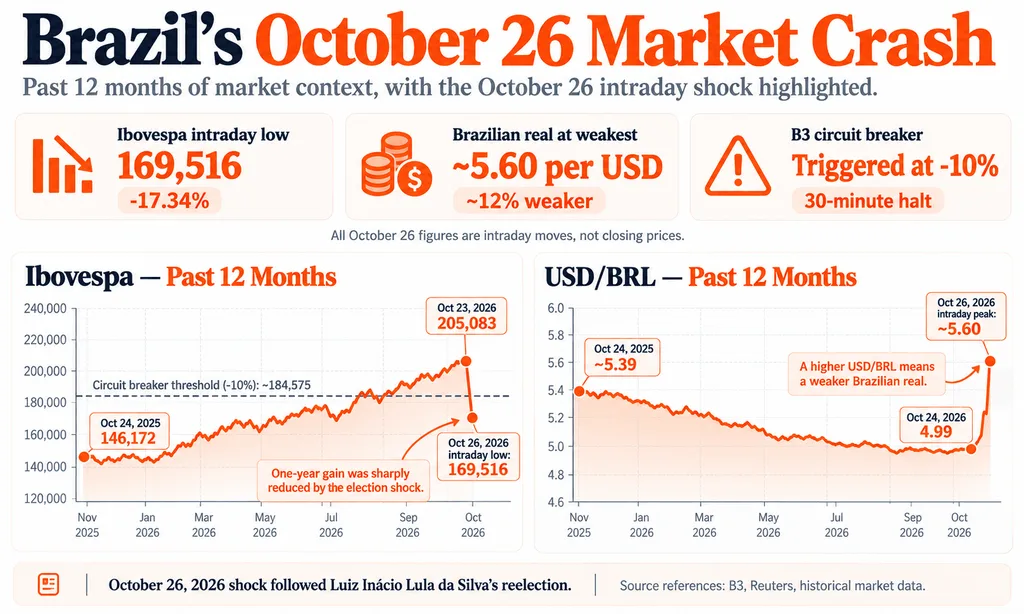
Brazil's stock market plunged as much as 17.34% on Monday, October 26, while the Brazilian real weakened nearly 12% against the US dollar, triggering a 30-minute trading suspension after President Luiz Inácio Lula da Silva secured an unexpected reelection victory.
The benchmark Ibovespa dropped to an intraday low of 169,516 points, according to local market reports. Brazil's exchange operator B3 confirmed that it activated its circuit breaker after the index initially fell 10% from Friday's closing level.
The selloff extended an earlier Brazilian market reversal, as investors unwound positions built around expectations of a victory by Lula's opponent, Flávio Bolsonaro.
Why Brazil's Stock Market Crashed After Lula's Victory
Lula secured 51.79% of the vote in Sunday's presidential runoff, defeating Bolsonaro, who received 48.21%. The outcome reversed expectations following Bolsonaro's first-round lead earlier in October.
Brazilian equities had rallied ahead of the vote, with the Ibovespa closing above 205,000 points on Friday. The real had also strengthened as investors anticipated changes to fiscal policy and government spending.
Monday's result reversed those trades.
At its deepest intraday decline, the Ibovespa lost more than 35,000 points from Friday's close. Meanwhile, the US dollar surged above 5.60 reais, compared with approximately 4.99 reais before the election.
The selling resembles other emerging-market crashes, where unexpected events force investors to rapidly reduce exposure.
Brazil's financial institutions and domestically focused businesses were among the hardest hit, reflecting concerns about future borrowing costs and economic policy.
Brazil's Treasury Cancels Bond Auctions as Real Collapses
The turmoil extended well beyond equities.
Brazil's Treasury cancelled scheduled fixed-rate and inflation-linked bond auctions as interest-rate futures surged. Longer-dated sovereign bonds also declined, with the 2056 maturity losing approximately 2.5 cents, according to Reuters.
These moves suggest investors are demanding greater compensation for holding Brazilian government debt, particularly amid uncertainty about public spending and debt sustainability.
The reaction parallels recent sovereign bond pressure in Europe, where concerns about fiscal deficits have pushed borrowing costs higher.
A weaker currency creates an additional challenge. Imported goods become more expensive in local-currency terms, potentially intensifying inflation pressures and limiting the central bank's ability to reduce interest rates.
The currency selloff also highlights how quickly foreign-exchange markets can reflect changing assessments of fiscal and political risks.
What Happens After Brazil's Trading Halt?
B3's circuit breaker temporarily suspends trading when the Ibovespa falls 10%. Under exchange rules, a further decline to 15% after reopening can trigger another one-hour halt, while a 20% drop allows additional intervention.
The mechanism does not establish a price floor or prevent further losses. It provides time for market participants to reassess orders during extraordinary volatility.
Brazilian investors now face two unresolved questions: whether Lula's administration will present a credible fiscal plan and whether bond and currency markets can stabilize.
The Treasury's cancelled auctions make the fiscal issue especially significant. Higher government borrowing costs can eventually affect corporate financing, household credit and economic growth.
Similar global bond-market pressures have demonstrated how quickly financing conditions can tighten when investors demand higher yields.