Key takeaways
- Anthropic's extreme scenario puts 2030 GDP at $44.4 trillion
- More moderate AI scenarios project substantially smaller economic gains
- Co-founder Jack Clark warns economic transformation requires stronger safeguards
Anthropic co-founder Jack Clark says artificial intelligence could help push US economic output toward $44 trillion by 2030, outlining an extraordinary growth scenario as policymakers debate the economic consequences of increasingly powerful AI systems.
Speaking at the IMF and World Bank annual meetings in Bangkok, Clark discussed an internal economic model suggesting that AI could dramatically accelerate productivity and the creation of new industries.
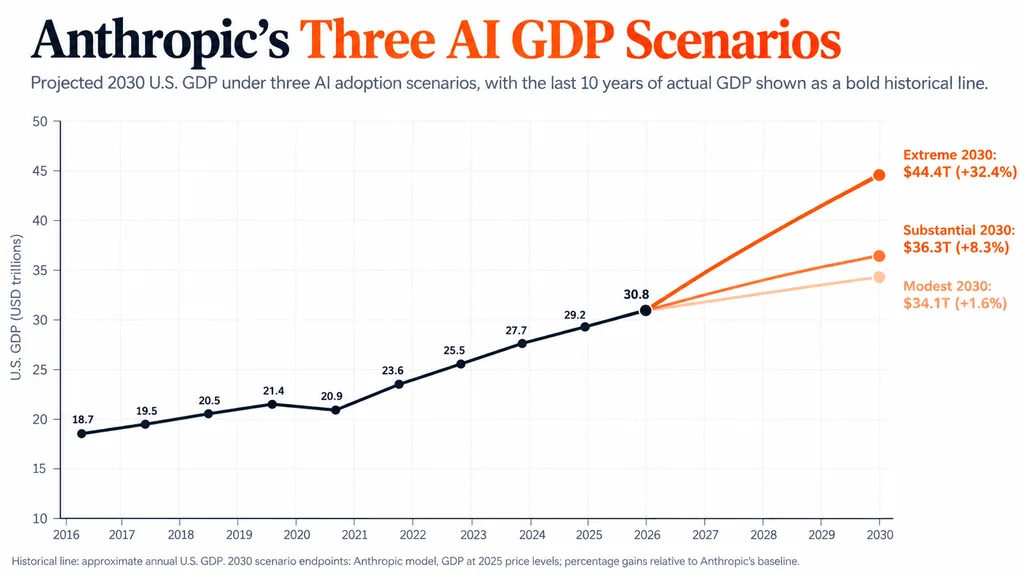
According to Anthropic's original research, its most aggressive scenario projects US GDP reaching $44.4 trillion by 2030, compared with $34.1 trillion under a modest AI adoption scenario.
Anthropic Models $44.4 Trillion US Economy by 2030
Anthropic's analysis presents three potential outcomes rather than one unconditional forecast.
Under its modest scenario, US GDP reaches $34.1 trillion in 2030, representing a 1.6% improvement over the model's baseline projection.
The substantial scenario produces $36.3 trillion, or 8.3% above baseline, while the extreme scenario reaches $44.4 trillion, approximately 32.4% higher.
All three estimates use constant 2025 dollars, allowing comparisons without changes in the price level distorting the results.
Clark acknowledged that the most optimistic outcome would require extraordinary changes across the economy.
In his October 17 remarks, reported by Reuters, he argued that continued AI improvements could accelerate scientific discoveries and create entirely new industries.
However, achieving the extreme scenario would require more than businesses simply replacing employees with AI software. New products, economic activities and productivity improvements would have to generate substantial additional value.
AI's Economic Promise Comes With Employment Risks
The research also examines how increased automation could affect employment and the distribution of economic gains.
Anthropic expects AI to create new tasks while automating existing ones, although the relative balance differs significantly between scenarios.
The company acknowledges that economic growth does not guarantee equivalent increases in workers' incomes.
Some productivity gains could disproportionately benefit capital owners and companies controlling advanced technology.
The debate comes as investors question the enormous infrastructure spending needed to develop advanced AI systems.
Major technology companies continue committing substantial capital to GPUs, data centers and electricity infrastructure. Yet the businesses receiving those investments are not necessarily those ultimately generating sufficient profits to justify them.
Understanding AI infrastructure spending has become particularly important as investors assess the returns on increasingly expensive computing projects.
Can AI Deliver Economic Growth as Tech Stocks Slide?
Clark's remarks arrive during a difficult period for AI-related investments.
Global technology funds recently recorded $4.75 billion in withdrawals, even as broader equity funds attracted approximately $20 billion.
US semiconductor companies also suffered a $1.64 trillion selloff across six sessions, reflecting concerns about valuations, borrowing costs and AI investment returns.
Those market losses do not invalidate Anthropic's long-term economic scenarios. They highlight the uncertainty surrounding how quickly productivity improvements can justify current spending.
Meanwhile, Clark called for stronger international cooperation and enforceable safeguards as increasingly capable AI systems create new security and governance challenges.