In This Article
PulseChain (PLS) has attracted attention in the crypto market as a high-throughput blockchain that is designed to offer faster transactions and lower fees than Ethereum. Since its launch, the project drew in a dedicated community and speculative interest from traders hoping the ecosystem could grow over the years.
With the cryptocurrency market expected to grow, many investors are asking an important question: what could the PulseChain price be in 2026? While no prediction can guarantee future performance, analyzing current market data, tokenomics, and expert forecasts can help create a realistic outlook.
This guide explores PulseChain’s fundamentals, current price trends, and possible price scenarios for 2026.
What Is PulseChain (PLS)?
PulseChain is a blockchain network that was created to function as a faster and cheaper alternative to Ethereum. It aims to improve scalability while maintaining compatibility with Ethereum-based applications.
The network uses proof-of-stake consensus and supports decentralized applications (dApps), smart contracts, and decentralized finance (DeFi) protocols. Its native cryptocurrency, PLS, is used for transaction fees, staking, and network governance.
PulseChain launched in 2021 and operates with an extremely large token supply of more than 14 trillion tokens, which helps explain its very small per-token price.
The network also mirrors many Ethereum assets, and its goal is to create a parallel ecosystem with faster throughput and lower fees.
PulseChain Current Price Overview
Currently, PulseChain trades at roughly $0.00001 per token, with relatively low daily trading volume compared to major cryptocurrencies.
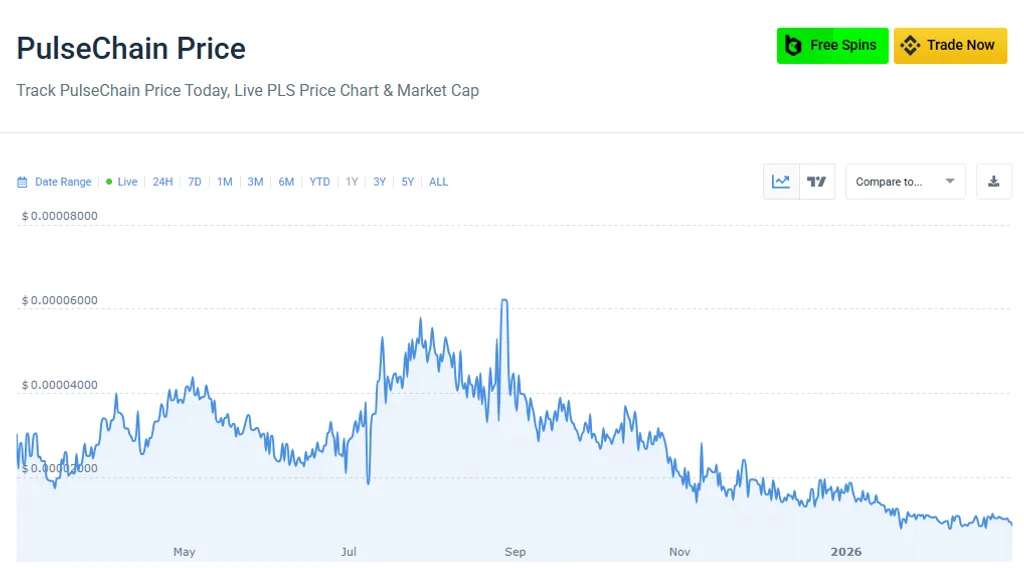
PLS’s price action over the past year (Source: CoinCodex)
Key metrics include:
Price: around $0.00001
Maximum supply: roughly 135 trillion PLS
Market ranking: outside the top 1000 cryptocurrencies
Because of its massive supply and niche ecosystem, PLS behaves differently from large-cap cryptocurrencies like Bitcoin or Ethereum.
PulseChain Price Prediction 2026
Price predictions for PulseChain vary a lot depending on the source, market conditions, and adoption of the network.
Average Market Forecast
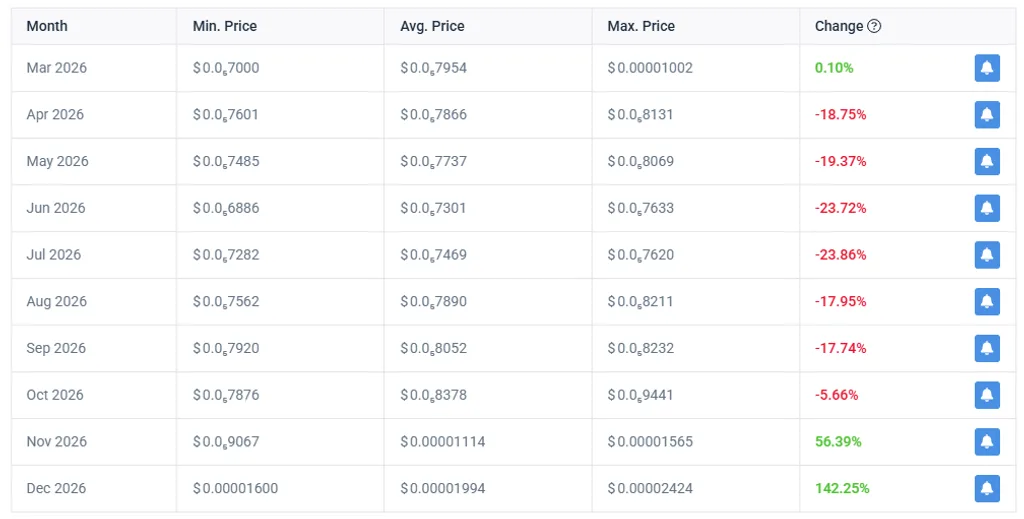
Some analytics platforms predict that PLS could trade between roughly $0.000007 and $0.000029 in 2026, depending on market momentum and adoption. If the higher range is reached, that would represent a potential gain of more than 170% from current levels.
Other forecasts suggest a more modest growth range, placing PLS around $0.000013–$0.000017 during 2026, assuming gradual ecosystem expansion.
Meanwhile, some projections suggest PLS may trade closer to $0.000011–$0.000014 by the end of 2026 if market conditions remain stable.
CoinCodex forecasts that this could be what the rest of 2026 may look like for PLS:
Key Factors That Could Influence PulseChain’s Price
1. Ecosystem Growth
The number of decentralized applications and DeFi protocols built on PulseChain will play a major role in its valuation. More developers and users could drive demand for PLS.
2. Crypto Market Cycles
Historically, altcoins tend to rise during crypto bull markets and decline during bear markets. If a major bull run occurs in 2026, PLS could benefit.
3. Token Supply and Inflation
PulseChain’s massive token supply can limit large price increases because market capitalization must grow substantially for the price to move significantly.
4. Exchange Listings
Listings on larger centralized exchanges could increase liquidity and accessibility, potentially boosting demand for the token.
5. Community Strength
PulseChain has one of the most loyal crypto communities. Strong community support can help sustain long-term ecosystem development.
Can PulseChain Reach $0.01 by 2026?
Many investors wonder whether PulseChain could reach $0.01, but such a scenario would require a massive increase in market capitalization due to the token’s enormous supply.
For PLS to reach $0.01, the network would need trillions of dollars in valuation, which is currently unrealistic in the near term.
More realistic long-term targets often discussed by analysts are:
$0.0001
$0.001
These would still represent maasive gains if the ecosystem expands.
Risks of Investing in PulseChain
While PulseChain has strong community support, it also carries several risks.
High volatility
Small-cap cryptocurrencies often experience extreme price swings.
Limited liquidity
Compared to major coins, PLS trading volume remains relatively low.
Regulatory uncertainty
The broader crypto sector continues to face evolving regulations globally.
Competition
PulseChain competes with established networks like Ethereum, Solana, and Avalanche.
Final Thoughts
PulseChain is still a high-risk, high-reward cryptocurrency with a dedicated community and a unique approach to scaling Ethereum-based applications. While some forecasts suggest PLS could reach around $0.00002–$0.00003 by 2026, actual performance will depend on market cycles, adoption, and development activity.
For investors, the most important factor is understanding that price predictions are speculative. Conducting thorough research, monitoring the ecosystem, and diversifying investments are essential strategies when exploring projects like PulseChain.